
Solar Powered 4G Router and Camera Systems
A base station site is a fenced compound with a locked gate, a tower that accepts no extra brackets, and network gear that never stops drawing. A solar powered 4G router setup puts the router, the cameras and the battery cabinet on their own mast outside the fence, so the compound stays untouched and the site keeps its eyes on the access road.
One mast like this is usually one unit in a larger rollout, and planning tower sites as a portfolio treats them that way.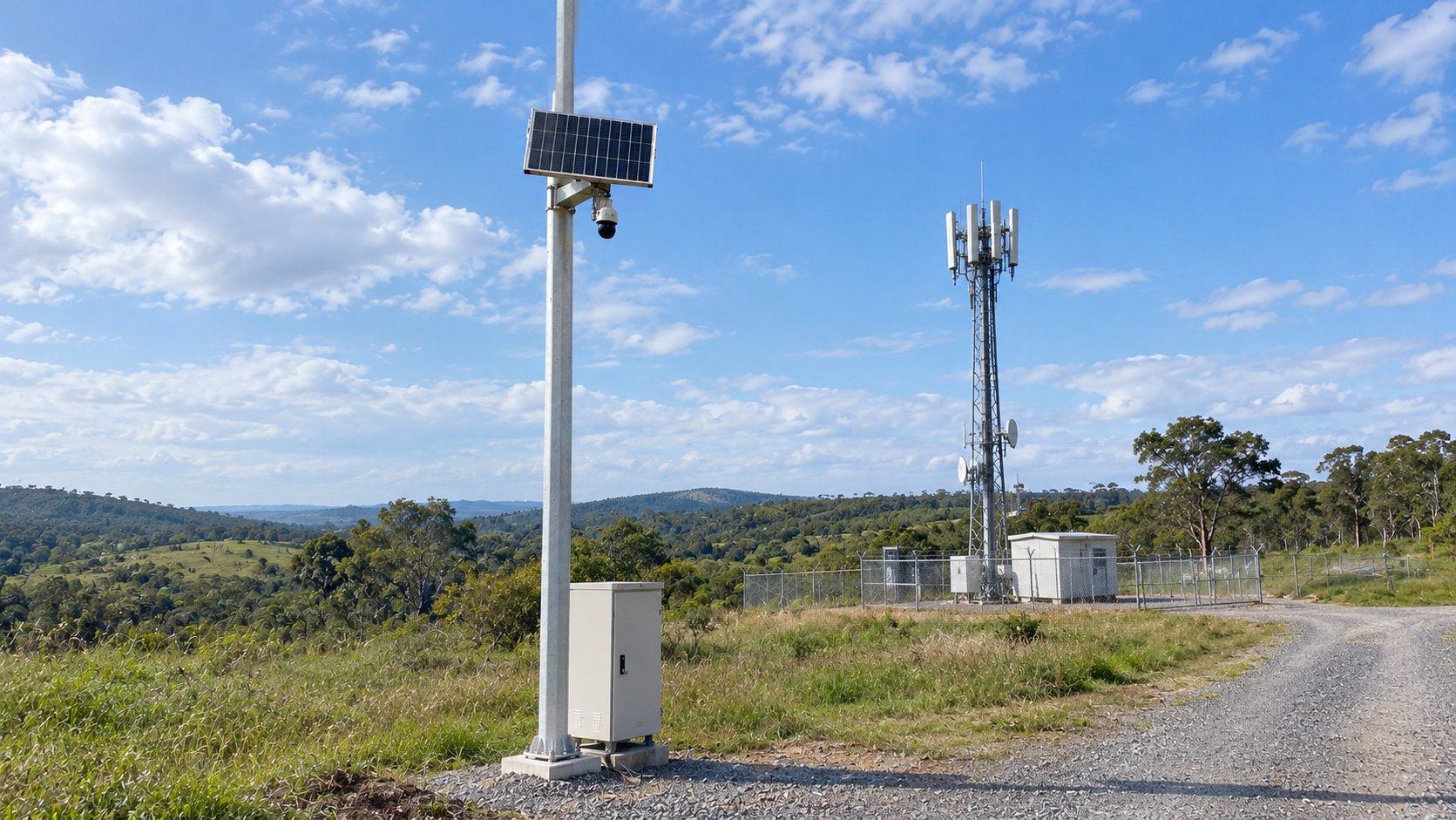
A Fenced Compound, a Protected Tower, and Gear That Never Sleeps
Camera coverage at a tower site is wanted outside the fence: the gate, the access road, the equipment cabinets, the turning area in front of the compound. Every one of those points sits on ground that belongs to somebody: the tower company inside the fence, the landowner outside it. Opening a trench across either one means permits, access agreements and a crew on site.
The network side adds its own rule. The tower steel and the compound internals are managed by the carrier or the tower company, and attaching an extra bracket to them is usually not something a visitor can decide. A self-contained system on its own mast avoids that conversation entirely: nothing is fixed to the tower, nothing is trenched, and the whole unit can be unbolted and moved if the site layout changes.
- No trenching: nothing is opened inside the compound or across the access road
- Tower steel untouched: the system stands on its own mast or a fence post
- Covers the approach, not the compound: gate, road and cabinet bays at the point of use
- Carries the always-on load: the battery keeps the router and the cameras running through the night
What a Tower-Site Point Usually Draws
A tower site differs from a camera-only site in one way: the router is a 24-hour base load, so the battery has to cover it every night, not just when something moves. Power for the data link is therefore the figure to fix before the camera count. These are our working reference figures: check your own router and camera labels before ordering.
| 4G / LTE router or CPE | 1 unit running continuously (≈8 W typical for a small industrial router) |
| Compound gate and cabinets | 1 fixed camera per bay (5–10 W each) |
| Access road and turning area | 1 mid-size PTZ camera (5–10 W) per coverage point |
| Site intercom or entry panel | small DC 12V load, add its label figure if one is planned |
Recommended load depends on the actual power draw of your router and cameras; total continuous load must not exceed 60 W (5 A at DC 12V). If the cameras are not chosen yet, start with how many watts solar panel for cctv camera and come back with the total.
One Router and Two Cameras, Hour by Hour
The numbers below are an illustrative example for low-power equipment, not a promise for every site. The usable energy of the battery is quoted at 12 V nominal, with the reserve the system keeps in hand and the conversion loss already taken off.
| Router, all day | 8 W × 24 h = 192 Wh |
| Gate camera, all day | 7 W × 24 h = 168 Wh |
| PTZ on the access road | 7 W × 24 h = 168 Wh |
| Total daily draw | 528 Wh, an average continuous load of 22 W |
A 60 Ah battery holds about 490 Wh usable, which is slightly below the 528 Wh this example draws in a day. On YO-P12060 the example therefore runs for about 22 hours from full, and the panel has to earn back the difference the next morning. A site that must ride through a whole dark day without help is the step up to YO-P12060’s larger sibling, YO-P240120, at about 979 Wh usable. Keep the average continuous draw under 60 W (5 A at DC 12V) regardless of panel size.
One Point, One Self-Contained System
Everything at a coverage point is powered from one standard system: panel, battery and outputs on the same pole or wall. The diagram shows how the pieces connect; the loads column is where your camera and router draw sits.
Total continuous load must not exceed 60 W (5 A at DC 12V). Recommended load depends on the actual draw of your cameras and router. Send us the models and we will check it for you.
Three Site Situations, Three Standard Models
Router plus one camera
YO-M8040: the 80w solar power system for camera, with an 80 W panel and 40 Ah battery on a steel bracket. A compact fit for a single gate camera and the router beside it.
Router plus gate and road cameras
YO-P12060: the 120w solar power system for camera adds a 120 W panel and 60 Ah battery, sized for a router plus several cameras within the 60 W output limit.
Own mast or fence post, no wall
YO-P12060-T: the pole mount solar power system for camera carries the same power core on a triangle bracket with pole clamps, for sites where the only mounting points are a mast and a fence. For several coverage points on one site, YO-P240120, the 240w solar power system for camera, is the step up.
Device counts are indicative only. Actual compatibility depends on the combined continuous power draw of all connected devices, including the router. The total load must remain within the system’s 60 W (5 A at DC 12V) output limit. Panel ratings (80 W, 120 W, 240 W) describe how much the panel array can harvest, not how much the output can deliver: the output limit is the same 60 W (5 A at DC 12V) on all four standard models.
Mounting Outside the Fence Line
Own mast beside the compound
A short mast outside the fence keeps the tower steel, the compound ground and the carrier’s equipment out of the job entirely. The battery cabinet hangs at working height and the camera looks along the access road.
Perimeter fence and gate posts
Where the fence posts are substantial, a clamp band on a corner post or beside the gate covers the entrance without a foundation. Ask the fence owner before drilling; most posts take a band without any.
Clear of the tower’s shadow
A lattice tower throws a narrow shadow that sweeps across the ground as the sun moves. Place the mast so the shadow never crosses the panel during the day, and re-check when trees or new antennas change the skyline.
Patient with the gate key
Because nothing is fixed inside the compound, the installation does not need to enter the carrier’s schedule at all. That is usually the difference between a one-day job and a permit queue.
Four Things That Only Matter at a Base Station
1. The compound is not your ground to open
Inside the fence, the ground, the cabinets and the cable routes belong to the carrier or the tower company. Any trenching there means their permit, their crew and their schedule. A system that stands outside the fence on its own mast removes the site owner from the critical path, and nothing has to be reinstated if the layout changes.
2. The router is the load that never sleeps
A camera records movement; a router forwards packets every second of the night. That is why the sizing conversation at a tower site starts with the router’s label figure, not the camera count. Add the router’s continuous draw first, then the cameras, and keep the total under the 60 W (5 A at DC 12V) output limit with margin to spare.
3. The tower steel is off the mounting list
Carriers design tower structures for their own antennas and approve every attachment. Extra brackets, even small ones, are usually refused, and ground space inside the compound is planned the same way. The practical answer is to bring your own steel: a mast that belongs to the camera system, standing outside the fence, needs nobody’s approval but the landowner’s.
4. The shadow moves all day
The lattice tower casts a narrow shadow that starts on one side of the site in the morning and ends on the other in the afternoon. A panel that is clear at noon can sit inside the shadow for an hour after sunrise and again before sunset. Walk the site once in the morning and once in the afternoon before choosing the mast position, and keep the panel clear of new antennas and trees as the site grows.
Asked by Site and Network Owners
Can one system power the 4G router and the cameras together?
Can it power the base station’s radio equipment?
Do we need permission to work inside the compound?
How long does the battery run without sun?
The Same Hardware on a Different Kind of Site
Where the fenced compound is temporary rather than a tower site, the same rig is bolted to whatever stands where the work is, which is construction site security camera solar power rather than a permanent mast.
The short answer to can one solar panel power multiple cameras, and the limits that go with it, sits with the other general sizing questions on the FAQ page; the step by step method is set out in this sizing walkthrough.
Two Other Sites Running the Same Kit
The load tables and mounting notes for three more sites where the cameras sit far from mains power are on the solar camera system for farm page for a remote gate, on the solar power for warehouse yard camera page for a yard point, and on the solar power for highway traffic camera page for a point between interchanges.
For a WiFi coverage point rather than a router backhaul, the loads are smaller and the overnight reserve matters more: the solar powered wifi hotspot page sizes it from the dark hours. Where the far end is a point-to-point bridge to another building, powering a bridge link runs the same account on the radio and its uplink.
Where the tower site carries a small coverage radio rather than a carrier backhaul, the site power design under solar power for rural internet tower covers radio, switch and camera in one budget.
Where the same radio serves a seasonal crowd rather than a fixed subscriber, the calendar-based sizing under solar power for campsite cameras fits better than a year-round average.
Tell Us What the Site Needs to Run
Send the router model and its rated draw, the camera count, and whether an intercom or entry panel shares the point. We will confirm the right standard model and quote it FOB China, typically with a reply within 24 hours.