
Solar Power for Camping and Event Site Cameras
A campsite or event ground sells the feeling of being somewhere safe, and a camera at the gate is part of what guests think they are paying for. But the gate has no power, the tents move every week, and trenching a cable across a site guests dig, drive and play on is a maintenance story nobody wants. Solar power for camping cameras puts each point on its own pole, sized for the busy weekend and the empty weeks either side of it.
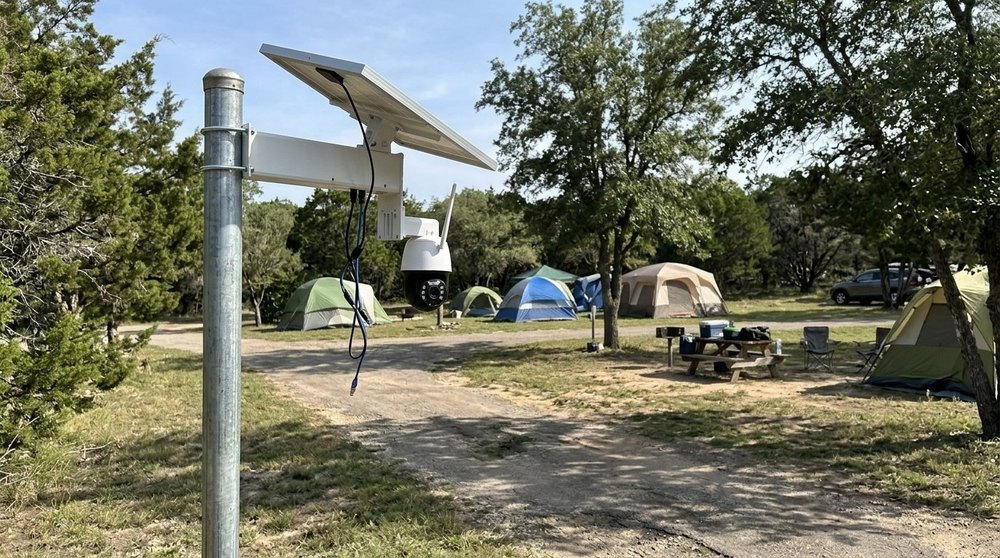
The Site Was Never Wired for Watching
Campgrounds and event sites grow along the land, not along a cable plan: a gate at the road, a commons by the water, a field that hosts a festival twice a year. The one grid connection serves the office, and everything past it runs on extension cords until the season proves that does not work.
Guests also rebuild the ground every week. Vehicles park off the pads, tents go in anywhere, and any cable run across the site becomes an obstacle, a trip claim and a repair within a season. A point with its own pole and its own power stands out of all of it: no trenching, no cord, and the camera ends up exactly where the sight line says it should be.
Sites like this are the clear-cut case; where the line between solar and wired sits is less obvious elsewhere.What a Campsite Camera Point Actually Draws
A campsite point usually carries more than a camera, because guests ask for the one thing the site cannot hand them: a signal. The power side of that signal is its own small, always-on load; powering the guest wifi point is worked through separately.
| Device at the point | Typical continuous draw | Watch for |
|---|---|---|
| Entrance or commons camera | 6–10 W typical | A PTZ draws more while moving; heating adds on cold nights |
| Guest WiFi access point | 8–12 W typical | Runs all night; guests treat the signal as part of the pitch |
| Path or gate light on a timer | 5–10 W typical | Evening hours only, but they are the hours guests arrive |
| Second camera at the water or the gate | 6–10 W typical | Each point is its own system; this line is for one pole only |
Reference values, not specifications. The label on your own equipment decides. Total continuous load at one point must not exceed 60 W (5 A at DC 12V).
One Point, One Self-Contained System
Everything at a coverage point is powered from one standard system: panel, battery and outputs on the same pole or wall. The diagram shows how the pieces connect; the loads column is where your camera and router draw sits.
Total continuous load must not exceed 60 W (5 A at DC 12V). Recommended load depends on the actual draw of your cameras and router. Send us the models and we will check it for you.
Three Campsite Situations, Three Standard Sizes
A gate camera with a short hop
YO-M8040: an 80W solar power system with a 40 Ah battery. Suits an entrance or office-side point with one camera, a staffed season and a visit as easy as walking past the office.
A commons point with guest WiFi
YO-P12060: a 120W solar power system with a 60 Ah battery. The standard choice where a camera, a guest access point and an evening light share one pole by the commons, and the night load is real.
A remote field that hosts events twice a year
YO-P12060-T for the same power core on a heavy triangle bracket where the point stands in the open, and YO-P240120 where the site sits empty for weeks between events and the point has to hold a 120 Ah reserve through them.
Building on Ground Guests Rearrange Weekly
Keep the pole out of the drive path
Guests arrive in the dark, towing and reversing. Set the pole back from the track with its own visible base, and mount the first camera high enough to see over vehicles rather than into them. A bent pole on a Saturday night is a lost point for the whole weekend.
Everything a hand can reach gets checked
A campsite is one of the few places where the public stands next to your hardware for a week at a time. Mount connectors at pole height, use fixings that need a real tool, and keep cable in conduit from the array to the enclosure so there is nothing loose to find.
Plan the aim for the full site, not the setup
Tents, marquees and parked vans all move. Check the camera’s view against the busiest layout the site allows rather than the current one, and confirm the array still sees the sky with the field full of shade-casting structures it will regularly hold.
Four Things That Only Come Up on a Camp Site
1. The calendar is the load sheet
Most weeks the point carries a camera and maybe an access point, and then an event weekend doubles the site: extra lighting, a second camera, vendor radios, a full commons until 2am. Size the reserve and the array for the event weekend, because that is the night the footage matters most, and a point that sags on the one busy Saturday is a point that was sized for the wrong week.
2. The camera is part of what guests are buying
Guests choose sites they can see are looked after, and a visible camera at the gate does more for bookings than a hidden one does for investigations. That argues for mounting hardware in plain sight, cleanly finished and signposted, rather than tucked away. On a campsite the appearance of the point is a commercial matter: a neat pole with a panel on it reads as investment, a messy one reads as neglect.
3. The trees are the site’s best feature and the array’s rival
Campsites are shaded on purpose, and the shade is seasonal: leaf-on in summer, bare in winter, and heavier every year as the trees grow. Site the array outside the canopy or raise it above the line the mature trees will reach, and remember that the summer shade that sells the pitches is exactly the season with the most sun to lose.
4. The empty weeks are the unattended weeks
Between events and outside the season, the site stands empty, the office is shut and nobody walks past the gate for weeks. That stretch is when equipment disappears and when a dead battery would go unnoticed. The reserve is sized from the longest unattended stretch the calendar shows, and the annual check rides the trip the owner already makes before opening weekend. Sizing is what keeps the point from going flat in the first place; when the reserve hits empty describes the failure being designed against.
Where the campsite doubles as the village’s WiFi point, the reserve and expectation notes under solar powered campsite wifi apply unchanged. Where the site edges into woodland, the canopy and access notes under solar power for fire watch cameras read across. And where the point stands on the high ground of a neighbouring tower site, the shared-pole layout under solar power for rural tower sites covers the radio half.
Asked by Campground and Event Site Owners
Can one pole carry the camera and the guest WiFi together?
What happens when there is an event and the load doubles?
Will guests interfere with the equipment?
Does the system need attention during the closed weeks?
Send the Calendar, Get the Sizes and the Reserve
Tell us where the points stand, what each carries and how long the site sits empty. We will map them onto standard sizes and quote FOB China. We are not the factory: we supply these standard systems, so where a site genuinely needs something else we will say so.
Plan the points
Number of points, device list, event calendar. We will come back with how many systems and which size for each, typically within 24 hours.
Ask Us to Plan ItCheck the numbers
Panel, battery, output and bracket for every standard size, on the product pages, so you can run the event-weekend arithmetic yourself.
See the DataMinimum order 2 pcs · FOB China · Payment is 100% in advance, by T/T bank transfer · Standard models · Typical lead time ~15 days