Solar Powered WiFi Hotspot for Sites With No Mains Power
Coverage is a question of height, and height is exactly what a site with no mains cannot buy: a pole needs a cable, a cable needs a trench, and the trench is usually why the hotspot never gets built. A solar powered wifi hotspot breaks that loop. The equipment is one access point and one router, the load is small, and the whole point of the design is that it does not stop when the sun goes down. Small is not zero, though: the uplink load is present every hour of the night and comes out of the battery like everything else.
That example covers the hotspot alone; what else shares that mast is the tower-site question.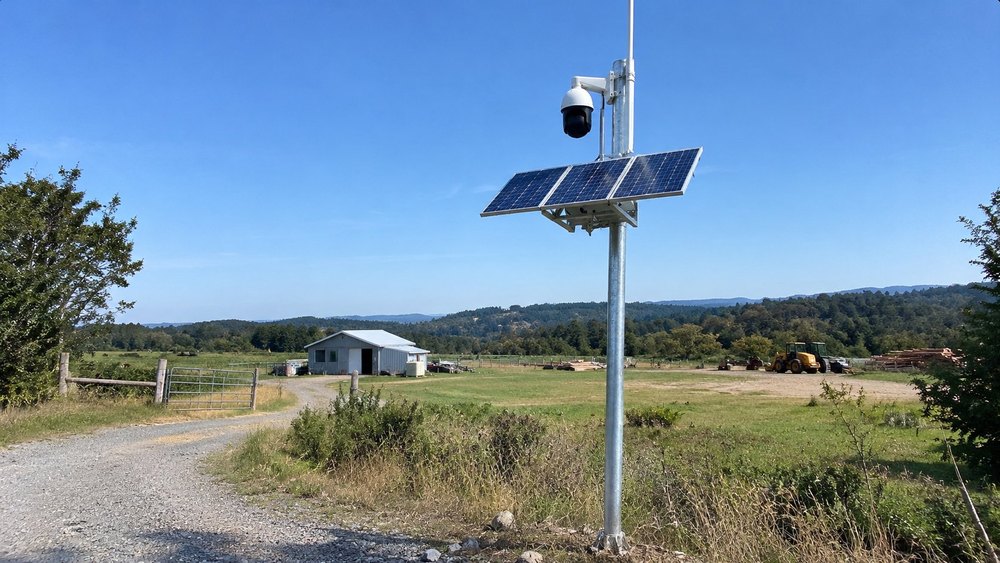
Small Load, No Restart
A hotspot is an easy electrical load and a difficult service. Two radios draw less than a single PTZ camera, so the array does not need to be large. But the value of coverage is entirely in its continuity: a hotspot that reboots at dusk is worse than no hotspot, because people stop trusting it and go back to their phones. The sizing target is therefore not the daily energy balance, which is trivial, but the number of consecutive dark hours the site has to ride through.
The locations follow the same logic. Yards, camps, markets, works compounds, beach car parks and rural junctions all want coverage, and none of them has a building with a socket at the right height. The pole is the whole project, which makes a self-contained pole the shortest route from a decision to a working network.
What a Hotspot Point Actually Draws
Everything at a hotspot point is a small number that never switches off, which is the combination that decides the battery rather than the panel. The failure that arithmetic is avoiding has a fixed shape; the night the battery empties walks through it.
| Device at the point | Typical continuous draw | Watch for |
|---|---|---|
| Outdoor WiFi access point | 5–12 W typical | Higher transmit power and more radios cost more current |
| DC 12V router or 4G CPE | 3–8 W typical | Present every hour whether or not anyone connects |
| Camera on the same pole | 5–10 W typical | The usual pairing, and it should be counted from the start |
| Small switch, sensor or PoE injector | 2–5 W typical | Only if it accepts DC 12V input |
Reference values, not specifications. The label on your own equipment decides. Total continuous load at one point must not exceed 60 W (5 A at DC 12V).
One Point, One Self-Contained System
Everything at a coverage point is powered from one standard system: panel, battery and outputs on the same pole or wall. The diagram shows how the pieces connect; the loads column is where your camera and router draw sits.
Total continuous load must not exceed 60 W (5 A at DC 12V). Recommended load depends on the actual draw of your cameras and router. Send us the models and we will check it for you.
Three Hotspot Situations, Three Standard Sizes
One access point over a yard or a gate
YO-M8040: an 80W solar power system with a 40 Ah battery. Enough for an access point and a small router, which is the whole requirement at a works compound gate or a single yard.
A hotspot with a camera on the same pole
YO-P12060: a 120W solar power system with a 60 Ah battery. The common build, because the camera that watches the yard wants to send its video over the same link, and both loads run through the night.
Two radios, a camera, or a site that cannot reboot
YO-P12060-T for the same power core on a heavy triangle bracket where the mast stands in open ground, and YO-P240120 where the pole carries an access point, a router and cameras together and the site has to survive a run of grey days without a visit.
Two Things Want the Top of the Pole
Antenna first, array on its own cross-arm
The access point wants height for coverage; the panel wants height for light and no shadow. Put the antenna at the top, hang the array on a separate cross-arm below or to the side, and check that the panel does not sit in the antenna’s main direction. Sharing one arm usually costs more in performance than a second bracket costs in money.
A stiff pole, not a tall one
Coverage improves with height, but a thin mast that sways in wind moves the antenna pattern with it and eventually works fixings loose. A shorter, stiffer pole with the access point at four to six metres beats a tall flexible one in most yards.
Data cables deserve the same care as power
The feed to the access point and the run to the camera are as exposed as the DC cable. Keep them in conduit on the pole, enter the enclosure from below, and let the installer decide any surge protection for the site, since it depends on earthing and on what else stands nearby.
Four Things That Only Come Up on a Coverage Point
1. The battery decides the project, not the panel
With a load this small, almost any array will refill the battery during the day. What limits the site is how long it can run with no sun at all, which is a battery question. Two radios at roughly 10 W for fourteen hours is about 140 Wh overnight; the reserve needed to ride two grey days on top of that is what moves the choice from one size to the next. Work the dark hours first and the array falls out of the answer.
2. Coverage radius is a customer expectation, not a specification
Every hotspot project begins with a number of metres, and that number depends on the client devices, the terrain, the buildings and whether they mean indoor or outdoor coverage. It is worth agreeing in the quotation what the site is for: a car park, a jetty, a row of tents or a work corridor. Designing to a stated area rather than to a stated radius avoids the conversation after commissioning.
3. Hotspot and camera are one project
Almost every hotspot enquiry turns out to include a camera, either at the same point or at a second one that needs the same coverage. That is a design advantage: the link, the pole and the visit are shared, and the video can travel over the network the hotspot already provides. It is also a load trap, because the camera is added after the small-load arithmetic was done. The arithmetic itself, hotspot first, is set out in how much power does a wifi hotspot use.
4. Off-grid internet is two problems wearing one coat
Power is only half of it. A hotspot with no upstream connection serves nobody, so the site also needs a cellular router, a directed link to a building or a satellite terminal, and that choice carries its own continuous load. Sites that ask for an off grid internet power system usually need both halves priced, and the router belongs on the load list next to the access point. Where that router feeds a point-to-point link rather than a coverage point, solar power for wireless bridge builds the list with the bridge radio in it.
Where the hotspot is standing in for a cellular base station rather than a WiFi network, the load and coverage notes under solar powered 4g router are the closer reference. Points spread across fields follow the same siting rules as solar power for farm security cameras, and a hotspot serving a pump house or a reservoir landing usually lands within a few metres of the point described under solar power for aquaculture cameras.
Where the coverage point is the tower itself, the site layout and theft-watch notes under solar power for rural tower sites take over.
Where the coverage point is a campsite or event field, the calendar and guest-facing notes under solar power for campsite cameras take over the sizing.
Asked by Site Managers and Network Installers
How long will it run without sun?
Can it power my existing router or access point?
What coverage area can one point serve?
Does the panel shade the antenna, or the antenna shade the panel?
Send the Devices, Get the Size
Tell us what has to run on the pole and what the site is for. We will map it onto standard sizes and quote them FOB China. We are not the factory: we supply these standard systems, so if the load genuinely needs something else we will say so.
Plan the point
Device list, coverage area, access for a pole. We will come back with the size and what it will carry, typically within 24 hours.
Ask Us to Plan ItCheck the numbers
Panel, battery, output and bracket for every standard size, on the product pages, so you can check the overnight arithmetic yourself.
See the DataMinimum order 2 pcs · FOB China · Payment is 100% in advance, by T/T bank transfer · Standard models · Typical lead time ~15 days