
Solar Power for Highway Traffic Cameras
A highway corridor is the opposite of a yard: the road runs for tens of kilometres, power exists at the interchanges and toll plazas, and the stretch in between has nothing. Solar power for highway traffic cameras closes those gaps with self-contained poles, so a camera can stand where the sightline demands rather than where the last cable ended. Solar power for roadside camera points follows the same rule: one pole, one system, no trench along the shoulder.
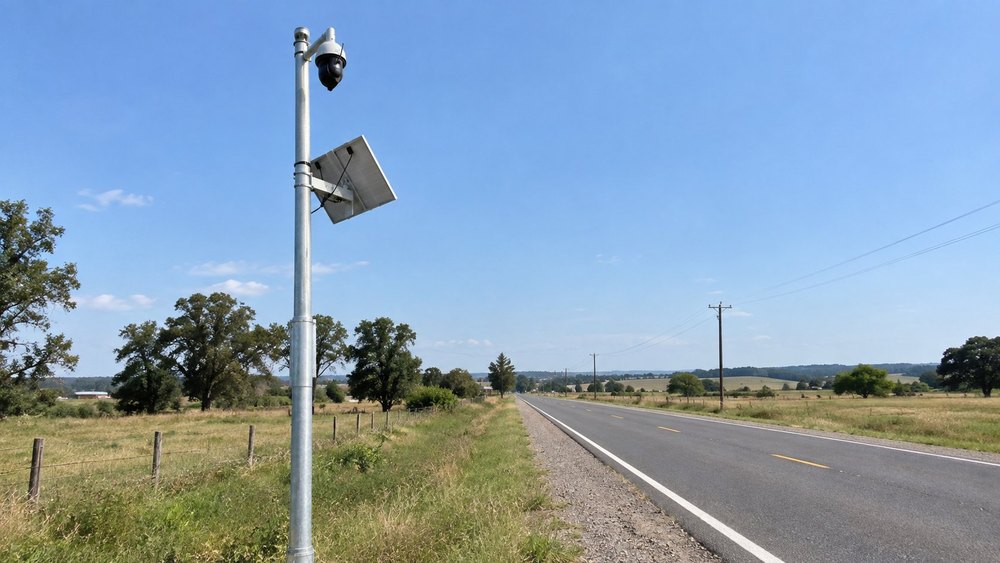
Between Two Interchanges Is a Dead Zone
Traffic authorities and road operators usually instrument the places where traffic already slows down: toll gates, interchanges, weigh stations. The long mid-block stretches between them stay unwatched, not because cameras are expensive but because the civil work is. Bringing a power cable along a highway shoulder means ducting, joint boxes, permits and lane closures, and the cost repeats for every kilometre. How those line items behave once they reach a quote is set out in the cost of a long cable run.
A camera on a solar pole sidesteps that chain entirely. The panel and battery arrive with the camera, the installation is one foundation and one crane day, and the point can sit exactly where the geometry wants it: on the outside of a curve, before a merge, or approaching a bridge where incidents cluster. When the road is resurfaced or widened years later, the same system moves to the new point instead of being abandoned with its trench.
What a Highway Camera Point Draws
A roadside point is rarely just a camera. The link back to the monitoring centre and any plate-capture or detection edge unit share the same pole, so they share the same battery. Router consumption in a remote cabinet is the part of that shared budget that never switches off.
| Device at the point | Typical continuous draw | Watch for |
|---|---|---|
| Traffic camera (PTZ or fixed) | 5–10 W typical | Peaks with assist light on and the lens touring presets |
| ANPR or radar edge unit | 2–5 W typical | Processes every vehicle, so it never sleeps |
| Wireless bridge or LTE router | ≈8 W typical | The link runs around the clock whether traffic passes or not |
Reference values, not specifications. The label on your own equipment decides. Total continuous load at one point must not exceed 60 W (5 A at DC 12V).
One Point, One Self-Contained System
Everything at a coverage point is powered from one standard system: panel, battery and outputs on the same pole or wall. The diagram shows how the pieces connect; the loads column is where your camera and router draw sits.
Total continuous load must not exceed 60 W (5 A at DC 12V). Recommended load depends on the actual draw of your cameras and router. Send us the models and we will check it for you.
Three Roadside Situations, Three Standard Sizes
A fixed camera at a lay-by or side road
YO-M8040: an 80W solar power system with a 40 Ah battery, sized for one fixed camera around 5–10 W plus a link. The lighter mast load makes it the easier fit where the pole stands in a narrow verge.
Camera plus ANPR plus link
YO-P12060: a 120W solar power system with a 60 Ah battery, the usual mid-corridor combination. Camera, edge unit and radio together commonly land between 15 W and 23 W, which this size carries through the night on stored power.
Open verge with no structure, or long overcast spells
YO-P12060-T puts the same power core on a heavy triangle bracket for a free-standing mast; YO-P240120 adds the 120 Ah battery reserve and a wider panel for points that must hold a full plate-capture duty through grey weeks.
Putting a Point on a Road Corridor
Clearances first, sightline second
A roadside pole stands in what road authorities call the clear zone, so its position and offset usually need approval from whoever manages the road. Settle that first; the system mounts the same way on any approved pole.
Shoot the lanes, not the headlights
Angle the camera across the lanes at the decision point rather than into oncoming light. Oncoming headlight glare at night behaves like the sun to a sensor, and a preset tour that faces west catches it every evening.
Cable above the mower line
Verge machinery is the ordinary enemy of roadside cable. Keep the battery box and conduit runs above the height a flail arm reaches, and keep the run short: camera, edge unit and radio all connect close to the pole they share.
Four Things That Decide a Highway Point
1. The backhaul picks the pole, not the other way round
On a mid-corridor stretch there is usually no fibre, so the footage leaves by LTE or by a wireless bridge to the nearest interchange building. Coverage and line-of-sight vary along a road, so survey the radio link before choosing the exact pole position. The link’s draw is small but permanent, and it belongs in the budget from the first line.
2. Night is when the road needs watching
Most incidents worth recording happen in the dark, and the assist light plus the always-on link mean the overnight load is nearly the same as the daytime load. Size the point on the night figure, not the noon figure, and the arithmetic stays honest all year.
3. Service access beats ideal geometry
A point on the median may see the junction perfectly, but reaching it means a lane closure. Where two positions give a similar view, choose the one a technician can stand at from the shoulder, and keep the battery box at a working height so the visit stays short.
4. Roads change; a standard system can move
Resurfacing, widening and new junctions relocate the traffic story every few years. Because each point is self-contained, relocation is a crane lift and a new foundation, not a decommissioned cable run. That flexibility is one of the quiet reasons road operators buy standard units instead of bespoke ones.
Two related cases sit next to this one. Where the radio path needs its own fixed site rather than a bridge to a building, the layout is under solar power for lte router. Where the corridor boundary is a fence line rather than a carriageway, the point-for-point method carries over from solar power for border fence camera.
Where the corridor leaves the road and climbs, the canopy, access and worst-month notes under solar power for forest fire watch camera take over the sizing.
Where the road reaches the water instead, the salt, splash and link notes under solar power for coastal surveillance camera apply to the same hardware.
Where the corridor runs through protected park ground, the closure calendar and public-facing hardware notes under solar power for national park camera replace the roadside ones.
Where the corridor is a haul road rather than a public carriageway, the relocatable point planning under solar power for mining site cameras is the closer match.
Asked by Road Operators and Contractors
Can one system cover several cameras along a stretch of road?
What happens to the footage where there is no fibre?
Can it run through a stretch of overcast winter days?
Can it power road lighting, signals or a variable message sign?
Send the Corridor, Get a Point-by-Point Quote
Tell us the stretch of road, the camera and edge units, and the radio link you plan to use. We will map the points onto standard sizes, flag any that do not fit, and quote the rest FOB China. We are not the factory: we supply these standard systems, and we would rather tell you early when something needs a different answer.
Plan the points
Corridor length, camera models, link type. We come back with how many systems and which size for each point, typically within 24 hours.
Ask Us to Plan ItRun the numbers yourself
Panel wattage, battery capacity, output limit and bracket options for every standard size are published on the product pages, so the load arithmetic is checkable line by line.
See the DataMinimum order 2 pcs · FOB China · Payment is 100% in advance, by T/T bank transfer · Standard models · Typical lead time ~15 days