Solar Power for Orchard and Vineyard Security Cameras
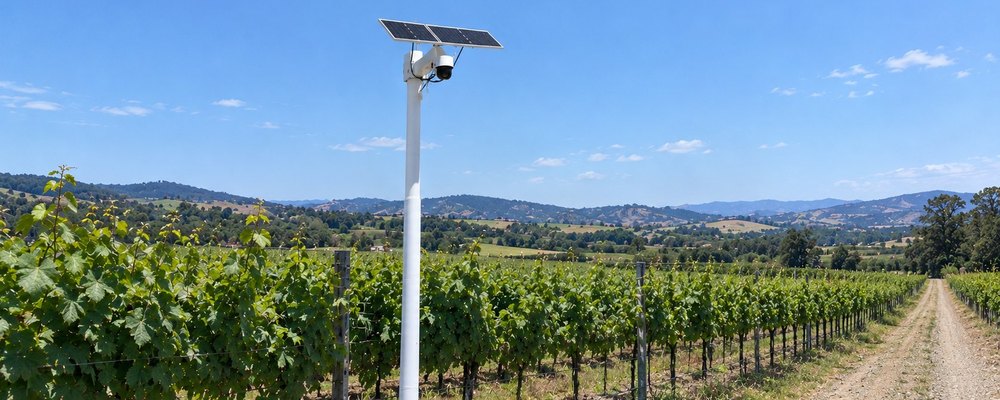
Rows of vines or fruit trees are an awkward place to pull cable, and usually the last place a utility will extend a line to. Our pole-mounted systems carry the panel, the battery and the camera on one post at the row head, so a block gets watched without trenching between rows and without asking the grid for a new connection.
What One Post at a Row Head Actually Draws
An orchard point is usually one camera watching the row head where the sprayer and the bins turn. If the block has no fixed line of sight, add a router for a link of its own. The numbers below are typical figures for 12V DC equipment, not a specification of your camera.
| PTZ camera, mid-size | 5–10 W while tracking |
| Fixed bullet camera | 3–6 W |
| 4G router or wireless bridge | 5–8 W, only where the point needs its own link |
| Total allowed at one post | under 60 W (5 A at DC 12V), whatever the panel size |
| Connector | 5.5 × 2.1 mm DC plug (DC5521) on the output leads. 5.5 × 2.5 mm will not fit, so check the camera plug before ordering. |
Any camera count quoted for an orchard is a worked example for low-power cameras. The binding limit is the combined continuous draw of everything on the post, which must stay under 60 W.
How long a battery carries a block through a cloudy stretch depends on the draw at the post, the light the panel actually collects at that latitude and season, and the battery capacity. A shaded valley block, an exposed ridge and a site with days of weak light are three different cases. We size a standard model to the draw you give us and do not promise all-day running regardless of weather.
One Solar System, Configured for the Actual Camera Load
One system is one power source, not one camera. The outputs can feed a camera and a router, or two camera points, as long as the combined continuous draw stays inside the output limit. The diagram shows the pieces and where your own draw sits; the table below carries the figures that decide it.
Total continuous load must not exceed 60 W (5 A at DC 12V). Recommended load depends on the actual draw of your cameras and router. Send us the models and we will check it for you.
Three Ways an Orchard Uses the Same Power Core
One row head, one camera
YO-M8040: this 80W solar power system puts an 80W panel and a 40Ah battery on a steel bracket, 10.0 kg, so one person can set the post. It suits a single row head or the headland where a track enters the block, with a camera and a router on the same post.
Two camera points on one block
YO-P12060: a 120W solar power system with a 60Ah battery, for a block where the row head and the store shed both need a camera. The 120 W is the panel rating, not what the cameras can draw: the output stays at 60 W (5 A at DC 12V) whatever the panel size. Both cameras can share the system only if their combined continuous power demand remains within the 60 W output limit and the voltage, connectors and cable runs are suitable. Confirm the wiring arrangement before connecting multiple devices.
No wall, only vine posts
YO-P12060-T: the same power core on a pole-mounted solar power system bracket, for a headland where there is no shed or wall to bolt a panel to and the post has to carry everything. For a whole estate with several blocks, YO-P240120 is the step up.
Mounting Around Rows, Not Through Them
Post at the headland
The headland is where the sprayer, the bins and the picking crew turn. A post in the middle of a row is hit by machinery within a season, so the row head is both the safest place for the hardware and the place a camera sees the most traffic.
Panel clear of the mature canopy
Vines and trees grow into the space above the post. Set the height from the canopy at full leaf, not from how the block looks at pruning, or the panel starts the season in shade and finishes it there. The bracket fixes to an existing post or a new steel post beside it.
Protected Cable Routing Along the Rows
Where the camera is installed away from the solar power unit, route the cable along a suitable support or use dedicated cable clips. Keep it clear of tractors, sprayers, pruning equipment and other moving machinery.
Do not assume that trellis wires are suitable cable supports in every installation. Protect the cable against abrasion, tension and accidental damage, and follow the cable manufacturer’s installation requirements. Nothing has to be buried, so replanting does not disturb the run.
Three Factors That Affect Orchard and Vineyard Camera Installation
Seasonal canopy shading
A panel that clears the canopy in March can be half covered in July. Before fixing the post, look at the block at full leaf and check the sun path against the row direction. Moving a post later means a new base and a new cable run.
Spray residue on camera lenses
Dust, sulphur and mist settle on a dome through the season, and a dirty dome at dusk is useless. A camera at working height, around 2.5 to 3 m, can be wiped from a quad bike. A 6 m mast means a ladder every spray pass, which in practice means it never gets cleaned.
Harvest traffic and camera visibility
For a few weeks a year the row head fills with bins, trailers and crews. Set the preset on the track and the store door rather than the open row, so the weeks that matter most are not the weeks the camera records a wall of plastic bins.
Solar Panel Placement and Seasonal Shading
Canopy height changes through the season, and a post that sees full sun at pruning can sit half in shade at full leaf. Before fixing the position, walk the block when the canopy is out and check what the panel will face through the day, in the month with the least sun rather than in the month you happen to be installing. Where shade cannot be avoided, panel size and battery capacity have to be judged against the real draw of the camera at that post, not against a rule of thumb about row widths.
For a block with limited maintenance access, send the camera model, the daily runtime you expect and the location of the site. We check whether a standard model covers that combination before quoting, and we will say so if the answer is that the site needs more panel than a standard unit carries. This is the part of the job that off-grid solar power for orchard cameras usually turns on, since the panel has to work with the shade the block actually has rather than the shade on a plan.
The Same Hardware on a Different Kind of Site
An orchard shares its layout with other row crops and its power problem with every site that has no mains at the point of use. A farm gate and barn set up is described in solar power for farm security cameras, and a covered growing operation under plastic is a different case again, since the panel sits on the structure rather than on a post in the open. Where the same post has to stand at a pond bank instead of a row head, the water rather than the crop sets the rules, which is solar power for remote location cameras. If the block has no line of sight back to the yard, the link is the issue rather than the power, and that case is covered by solar powered 4g router.
Where the crop sits under cover rather than under sky, the same points reappear in a different form, and the solar power for greenhouse monitoring page walks through the siting around a film structure.
The method for working out panel size from a camera label, step by step, is in sizing a panel from the camera label. Lead time and packing are on shipping and lead time.
Orchard and Vineyard Questions
Can a solar power system run security cameras in a remote orchard?
Yes, where the system is sized for the equipment. Our standard models supply compatible 12V DC cameras with no mains connection at the block. What decides the model is the draw of the camera, the hours it runs, the light the site gets and the backup you want through a cloudy spell.
Will tree shade affect an orchard solar power system?
Yes. Canopy growth through the season reduces charging and shortens the backup available at night. Check the panel position with the canopy out, and treat a heavily shaded row as a case to send to us rather than one to solve by buying a larger panel on its own.
Can one solar power system supply multiple vineyard cameras?
Possibly, and the deciding number is the combined continuous draw of everything on the post, including a router if there is one. Our standard systems are limited to 60 W at DC 12V in total, which is 5 A. Two low-power cameras and a router can fit inside that figure; two larger PTZ units often do not. Confirm the labels on your own devices before ordering.
What information is needed to select a system for an orchard?
Send the camera model and its rated power, how many camera points the block needs, whether a router shares the post, where the site is, and how long you expect the system to run without useful sun. With those five answers we can say which standard model fits or whether the site falls outside the standard range.
Send the Block Details and We Will Name One Model
Tell us the camera model, how many points the block needs and whether a router shares the post. We will confirm the standard model, quote it FOB China, and reply typically within 24 hours. Payment is 100% in advance by T/T and typical lead time is about 15 days from receipt of payment. Minimum order is 2 pcs.