
Solar Power for Rural Internet Towers
A rural internet tower exists because the grid did not reach that spot either, and the same distance that makes the tower necessary makes it expensive to power. Solar power for rural internet towers answers for the radio, the switch and increasingly for the camera that watches the site, because unmanned towers in open country lose equipment to theft before they lose it to weather.
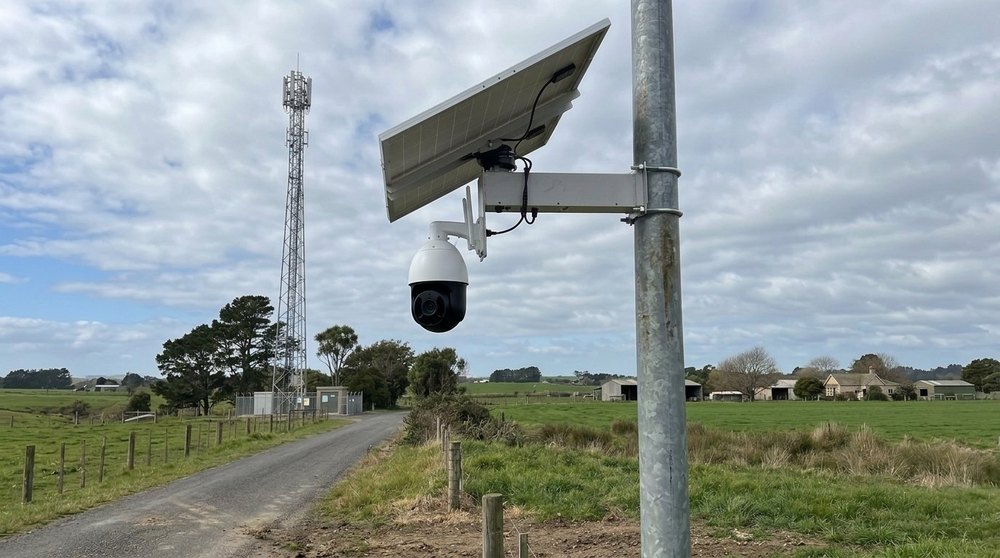
The Tower Sits Where the Cable Stopped
Rural coverage points are placed by radio geometry: a rise outside the village, a corner of farmland with a clear path to the houses served. The grid was never extended there, and a line run out to a single mast costs more than the site earns.
The tower keeps its own power budget, and the camera has joined it. Unmanned masts hold copper, radios and batteries that resell easily, and a site with no neighbour cannot rely on anyone reporting a visitor. A camera point changes that, and it usually shares the tower’s power problem: one pole, one array, one reserve covering both the connection and the watch.
What a Rural Tower Site Actually Draws
A small tower site carries the network gear first and the camera second; both run around the clock, and both fit in one system’s budget when the radio is a coverage unit rather than a carrier backhaul.
How the same budget is planned across several masts is set out in the portfolio view for tower sites.| Device at the site | Typical continuous draw | Watch for |
|---|---|---|
| Broadband radio or backhaul unit | 10–15 W typical | The largest single consumer; check the radio’s own datasheet, not the tower’s |
| Switch or small router | 4–6 W typical | Small but permanent, all night included |
| Camera watching the site | 6–10 W typical | A PTZ draws more when it moves; heating adds on cold nights |
| Second radio or mesh node | 5–10 W typical | Each added hop is a permanent line in the budget |
Reference values, not specifications. The label on your own equipment decides. Total continuous load at one site must not exceed 60 W (5 A at DC 12V).
One Point, One Self-Contained System
Everything at a coverage point is powered from one standard system: panel, battery and outputs on the same pole or wall. The diagram shows how the pieces connect; the loads column is where your camera and router draw sits.
Total continuous load must not exceed 60 W (5 A at DC 12V). Recommended load depends on the actual draw of your cameras and router. Send us the models and we will check it for you.
Three Tower Situations, Three Standard Sizes
A relay point with a fixed camera
YO-M8040: an 80W solar power system with a 40 Ah battery. Suits a small relay or repeater site with one fixed camera, a short hop to the next point and a road close enough for a routine visit.
A coverage site with radio and camera sharing
YO-P12060: a 120W solar power system with a 60 Ah battery. The standard choice when a broadband radio, a switch and a PTZ run from the same pole and the village depends on the link staying up.
A remote mast that rides out bad weather
YO-P12060-T for the same power core on a heavy triangle bracket where the mast stands exposed on rising ground, and YO-P240120 where the drive out takes hours and the site has to hold a 120 Ah reserve through a grey week.
Building Beside a Tower You Do Not Own
Your pole, not the tower’s steel
Clamping hardware to someone else’s mast needs the owner’s structural permission and a lease that outlives the project. A freestanding pole a few metres away keeps the permission to one landowner and the maintenance to one crew, and the array gets an aim of its own.
Stand clear of the radio’s view
The array is a metal plate, and a metal plate in the fresnel path is an outage waiting to be diagnosed for a week. Site the panel below or beside the link path, confirm the bearing before the foundation, and the radio and the panel stop fighting each other.
Earthing follows the site’s own rules
Tower sites carry lightning protection and bonding standards decided by the operator and the installing contractor under local rules. What a standard system contributes is a metal enclosure that can be bonded, short cable runs and nothing that wanders between the two structures.
Four Things That Only Come Up on a Rural Tower
1. The camera exists because the site gets robbed
Remote masts lose radios, copper and batteries to visitors with tools, and the loss usually shows up as an outage before anyone sees the footage. That is why the camera and the radio belong in one power budget: the equipment worth stealing is also the equipment that has to keep running while it is being watched. Sizing the reserve for the radio alone and treating the camera as an extra is the mistake that leaves both dark after one bad week.
2. Uptime is the product, not a feature
A village or a farm cluster plans around the link being up, and at a remote site the outage is not fixed by the afternoon. The reserve is therefore sized for the stretch of weather the site will actually see, not for the average month. Work the daily need from the full load list, check the array’s worst-month output on site, and let the brighter months accumulate as margin instead of being counted as capacity.
3. One budget for connection and watch
The radio, the switch and the camera all draw around the clock, and they fail together when the battery does. That is a reason to size generously and to keep the total continuous load under 60 W (5 A at DC 12V): a site that needs more than that is two sites, and pretending otherwise buys an outage with a fixed schedule.
4. Access decides the reserve more than the load does
Two sites with identical equipment lists can need different systems, because the one three hours out rides every fault alone. Count the realistic visit interval from the road, not from the map: if a grey week is followed by a flooded track, the site needs the reserve for both. Distance from the crew is the honest variable in rural power, and it is usually larger than expected.
Where the tower also carries the district’s mobile coverage, the backhaul notes under solar power for lte router cover the link side of the same site. Where the coverage point doubles as the village WiFi, the reserve and expectation notes under solar powered wifi hotspot apply unchanged. And where the tower stands in farmland, the access and load notes under solar camera system for farm read across.
Where the campsite sits in the shadow of a district tower site, the shared-pole and theft notes under solar power for event site cameras read across.
Asked by Rural ISPs and Site Owners
Can one system power the radio and the camera together?
Can we mount the panel on the tower itself?
How is this different from a WiFi hotspot site?
What happens after a week of cloud?
Send the Load List, Get the Size and the Reserve
Tell us what runs on the mast, how far the crew has to drive and how long the grey season lasts. We will map it onto standard sizes and quote FOB China. We are not the factory: we supply these standard systems, so where a site genuinely needs something else we will say so.
Plan the site
Device list, drive time, weather window. We will come back with which size and what reserve, typically within 24 hours.
Ask Us to Plan ItCheck the numbers
Panel, battery, output and bracket for every standard size, on the product pages, so you can run the grey-week arithmetic yourself.
See the DataMinimum order 2 pcs · FOB China · Payment is 100% in advance, by T/T bank transfer · Standard models · Typical lead time ~15 days