
Solar Power for Forest and Mountain Fire Watch Cameras
Fire watch points are chosen for what they can see, never for how easy they are to power. A ridge with a clear view over three valleys is also a ridge with no road, no cable and the least reliable weather on the property. Solar power for forest fire watch cameras is the only practical answer at that kind of point, and the sizing question is not the average month but the month the site has to stay awake.
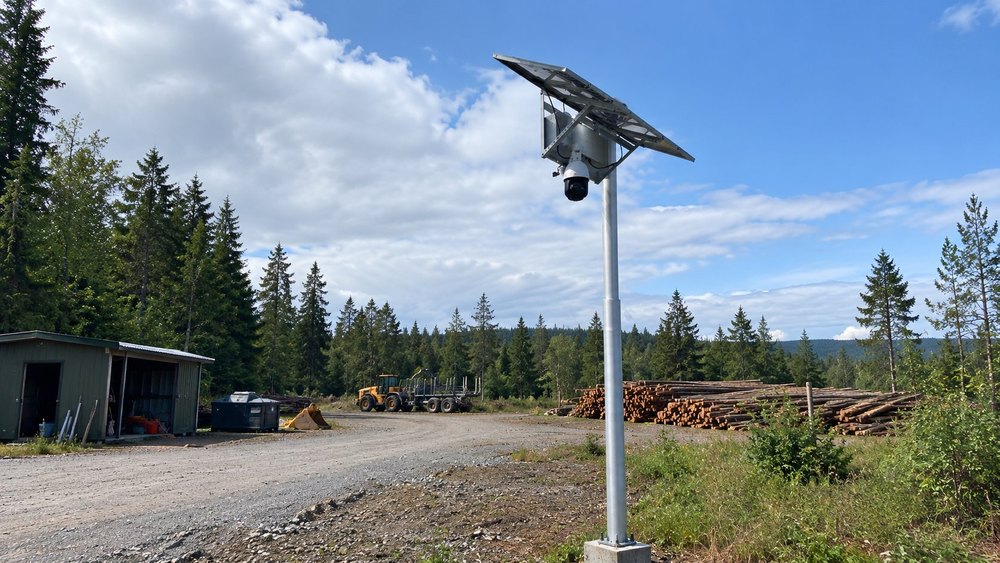
The Point Is Where the Cable Cannot Go
A forest watch network is designed around sight lines: a tower or a pole at each high point, each able to see the ground the previous one cannot. That logic puts hardware on ridges, in clearings and at trail junctions, and every one of those locations has the same two properties: no power, and no vehicle access for most of the year.
Grid extension to a single ridge point is rarely worth pricing, and a generator needs fuel deliveries that the site cannot support. The self-contained point solves both at once: energy is collected where the camera stands, and the only recurring visit is the one a ranger makes anyway. The design question then becomes honest and narrow, which is whether the array and battery can carry the site through its worst month rather than its best.
What a Fire Watch Point Actually Draws
Fire watch hardware is heavier than an ordinary security camera, and the radio link is often the largest single consumer at the point rather than a detail.
| Device at the point | Typical continuous draw | Watch for |
|---|---|---|
| Camera, including a thermal channel | 8–12 W typical | A thermal core draws more than a visible sensor alone |
| PTZ head, with heater if fitted | 3–8 W typical | Heating runs on cold nights, which is when the load peaks |
| Radio link to the ranger base | ≈8 W typical | Always on, and the only path for the video |
| Repeater or sensor node at the same point | 2–5 W typical | Adds up quietly across a network |
Reference values, not specifications. The label on your own equipment decides. Total continuous load at one point must not exceed 60 W (5 A at DC 12V).
One Point, One Self-Contained System
Everything at a coverage point is powered from one standard system: panel, battery and outputs on the same pole or wall. The diagram shows how the pieces connect; the loads column is where your camera and router draw sits.
Total continuous load must not exceed 60 W (5 A at DC 12V). Recommended load depends on the actual draw of your cameras and router. Send us the models and we will check it for you.
Three Forest Situations, Three Standard Sizes
A fixed camera at a trail head or gate
YO-M8040: an 80W solar power system with a 40 Ah battery. Fits a fixed camera at an accessible entry point with a short radio hop to a building, where a visit is easy and the array has a real chance of open sky.
A PTZ on a low ridge with a link
YO-P12060: a 120W solar power system with a 60 Ah battery. The common mid-slope configuration, where the view is worth a PTZ and the video has to leave by radio rather than by cable.
An exposed watch point that must not go dark
YO-P12060-T for the same power core on a heavy triangle bracket where the mast stands in open ground, and YO-P240120 where the fire season runs into the grey months and the point has to hold a 120 Ah reserve instead of relying on the current week’s weather.
Building a Point Where Nothing Can Be Delivered by Truck
Clear the canopy, then allow for growth
The array has to sit above the trees it stands among, and the trees are not finished. Site the panel for the canopy in ten years rather than the canopy next spring, or plan the mast so the array can be raised later without a second foundation.
A mast of its own, not a tree
Fixing hardware to a trunk looks economical and is a maintenance trap: the tree grows, moves in wind and eventually sheds the bracket. A short guyed mast on its own footing keeps the aim stable and lets a technician work at a predictable height.
Assume something will chew the cable
Cable on a forest floor is food or an obstacle to wildlife, and a damaged run is a two hour walk before any diagnosis begins. Keep every exposed length in metal flexible conduit, route it high rather than along the ground, and leave a service loop at the enclosure.
Four Things That Only Come Up on a Forest Point
1. Size for the fire season, not the annual average
The month the system exists for is usually the month with the least sun: late winter and early spring in many fire regions, when fuel is dry, humidity is low and the days are still short. A design that balances on an annual average will go dark in exactly the period an operator cares about. Work the sizing from the worst consecutive stretch the site is expected to ride through, and let the brighter months run as margin.
2. Snow and rime change the array, not just the sky
At altitude, a covered panel produces nothing regardless of how much light is in the air. A steeper mounting angle and a taller mast both help the array shed what lands on it, and a panel within reach from the ground is easier to clear after a weather event than one at the top of a tower.
3. Every fault costs a walk
Maintenance on a forest network is measured in hours of walking, so the specification should favour the parts that fail quietly: a larger reserve rather than a tighter one, sealed connectors rather than exposed terminals, and an enclosure a person can open and read without special tools. Where two points could share one difficult location, give each its own system rather than one long run between them.
4. An exposed ridge is the wrong place for optimistic assumptions
Watch points are chosen for visibility, which puts them at the highest, most exposed ground in the area. That affects the mechanical design far more than the electrical one: the foundation, the mast and the bracket carry the weather, and any lightning protection or earthing at the point is a site electrical matter decided by the installing contractor under local rules, not something a standard kit settles in a brochure.
Watch points that end at a road usually share their layout with the corridor work described under solar power for highway traffic camera, because the access question and the link question are the same. Where a forest boundary is fenced and patrolled rather than watched for fire, the point design follows solar power for border fence camera. An exposed coastal site with salt in the air rather than trees around it is covered under solar power for coastal surveillance camera.
Where the watch point sits inside park boundaries, the closure season and public-access notes under solar power for national park camera apply to the same hardware.
Asked by Forest Managers and Watch Point Installers
How do you size a point that has to run all fire season?
Can one point cover a whole valley?
Does a thermal camera change the sizing?
What about lightning and earthing at an exposed point?
Send the Site, Get the Points and the Sizes
Tell us how many watch points, roughly what each has to see, and how far it is from vehicle access. We will map it onto standard sizes and quote them FOB China. We are not the factory: we supply these standard systems, so where a site genuinely needs something else we will say so.
Plan the points
Number of points, device list, distance from access. We will come back with how many systems and which size for each, typically within 24 hours.
Ask Us to Plan ItCheck the numbers
Panel, battery, output and bracket for every standard size, on the product pages, so you can run the worst month arithmetic yourself.
See the DataMinimum order 2 pcs · FOB China · Payment is 100% in advance, by T/T bank transfer · Standard models · Typical lead time ~15 days