
Solar Power for Island and Coastal Surveillance Cameras
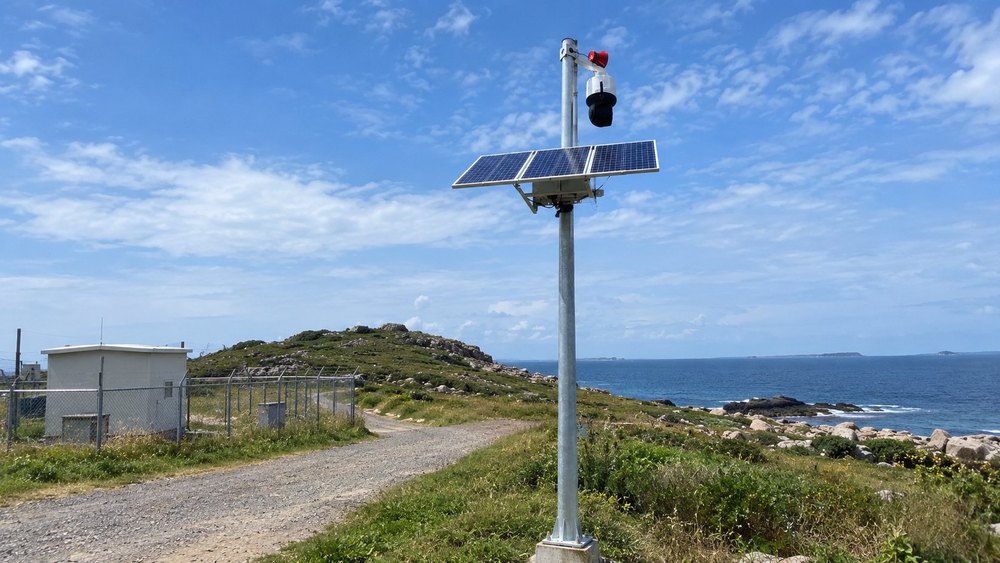
A coastline is generous with wind, salt and light, and short of almost everything else: no grid along the shore, no fresh water to rinse hardware, and on an island no road to the far side of it. Solar power for coastal surveillance cameras works because the resource and the problem sit in the same place. What the site demands of the design is mostly about position and access, not about the electrical maths.
Water Everywhere, Power Nowhere
Coastal surveillance follows the water: a jetty, a landing, a stretch of shoreline where vessels come and go. None of those places has a building to take power from, and coastal ground is the last place anyone wants to trench. On an island the question is sharper still, because the nearest grid point may be across a channel, and a cable to it means a marine survey before it means a quotation.
Gulf and Red Sea sites, which make up a good share of enquiries for this page, get the two useful things for free: strong irradiance and plenty of it. That is also why a coastal point is rarely the hardest sizing job in a project. The difficulty is elsewhere, in what the air does to hardware and what it costs to get a technician to an island in the middle of a working week.
What a Coastal Point Actually Draws
A shoreline camera is usually a PTZ with a long reach, and it is often the sensor size rather than the motor that sets the load.
| Device at the point | Typical continuous draw | Watch for |
|---|---|---|
| Long-range PTZ camera | 8–15 W typical | Larger sensors and stronger IR cost more current |
| Directed radio link to shore | ≈8 W typical | Always on, and the only path for the video |
| Heater or blower, if fitted | 3–8 W typical | Runs at night and in bad weather, when the load peaks |
| Radar, AIS or sensor unit on the same pole | 3–10 W typical | Popular on harbour jetties and easy to overlook |
Reference values, not specifications. The label on your own equipment decides. Total continuous load at one point must not exceed 60 W (5 A at DC 12V).
One Point, One Self-Contained System
Everything at a coverage point is powered from one standard system: panel, battery and outputs on the same pole or wall. The diagram shows how the pieces connect; the loads column is where your camera and router draw sits.
Total continuous load must not exceed 60 W (5 A at DC 12V). Recommended load depends on the actual draw of your cameras and router. Send us the models and we will check it for you.
Three Coastal Situations, Three Standard Sizes
A jetty or gate camera close to the mainland
YO-M8040: an 80W solar power system with a 40 Ah battery for a fixed camera at a landing or harbour gate, where the video leaves by a short hop and a visit is a walk rather than a boat.
A PTZ plus a link across a channel
YO-P12060: a 120W solar power system with a 60 Ah battery. A mid-range coastline point where the camera has to reach out over water and the video has to cross it by radio.
An island point with no wall to fix to
YO-P12060-T puts the same power core on a heavy triangle bracket for an open-ground mast, which is the normal case on a shoreline. YO-P240120 where the point carries a radar or a second camera and the 120 Ah reserve buys days of weather without a visit.
Positioning for Salt, Spray and a Boat Instead of a Van
Above and back from the splash line
Spray carries salt further inland than most people expect and lands highest on whatever faces the water. Set the point back from the immediate shoreline and put the enclosure and the array above the reach of breaking water, on the landward side of the mast.
Every entry facing down
Water runs along a cable and into an opening that faces it. Gland every entry from below, keep a drip loop where a run changes direction, and treat every joint as something that will be inspected rather than something that will be forgotten.
Few pieces, two people
An island delivery is a boat and a walk, so the parts count matters as much as the weight. A standard kit ships as panel, pole or bracket, battery box and cables, each light enough for two people to move. Plan the assembly on the beach and carry it up once.
Four Things That Only Come Up on a Coastline
1. Salt arrives as airborne moisture, not as sea water
The damage on a coastal point rarely comes from a wave; it comes from a film of salt that settles every day and stays there until something rinses it. There is no fresh water on an island to do that rinsing, which is why position does most of the work: landward side, above the splash line, entries facing down, and a routine inspection rather than a promise printed on a datasheet.
2. The sea path is the link path
An island point is usually connected by a directed radio link rather than by cable, and that link is the largest always-on load at the pole after the camera. It has to clear water, which means the far end’s height matters as much as the near end’s. Agree the link before fixing the mast height, because raising a mast later is a second trip.
3. A structural question stays a structural question
Coastal sites attract the hardest weather in a region, and it is worth being precise about what a standard power kit settles and what it does not. The kit specifies panel, battery, output and bracket. Whether a given mast and footing suit a given shore is decided on site, by whoever designs the foundation, against the local structural rules for that coast. We do not publish survivability figures for named weather, and any supplier who does should be asked for the calculation behind them.
4. Distance to a technician sets the reserve
On the mainland a weak battery is an inconvenience. On an island it is a boat, a weather window and a lost day. That asymmetry is the argument for the larger reserve on these sites: not because the coast is short of sun, but because the cost of an unplanned visit is measured in days rather than hours. Where a point genuinely carries a heavy list, go up a size rather than shave the margin.
Coastal sites that are watched from a road rather than from the water share the access logic described under solar power for highway traffic camera. Where the point sits in dunes, scrub or a treeline behind the shore, the siting notes under solar power for fire watch cameras apply to the panel position. And where the video has to leave by a cellular link instead of a directed hop, the load figures under solar powered 4g router are the right reference.
Asked by Harbour Operators and Coastal Installers
Will salt air damage the system?
Can it survive a hurricane or a named storm?
How does the video get back to the mainland?
How is it delivered to an island?
Send the Shoreline, Get the Points and the Sizes
Tell us how many points, how each one is reached and what has to run at the pole. We will map it onto standard sizes and quote them FOB China. We are not the factory: we supply these standard systems, so where a site genuinely needs something else we will say so.
Plan the points
Number of points, access method, device list. We will come back with how many systems and which size for each, typically within 24 hours.
Ask Us to Plan ItCheck the numbers
Panel, battery, output and bracket for every standard size, on the product pages, so you can check the reserve arithmetic yourself.
See the DataMinimum order 2 pcs · FOB China · Payment is 100% in advance, by T/T bank transfer · Standard models · Typical lead time ~15 days