
Solar Power for Aquaculture Pond Cameras
A pond bank is one of the few places where running mains cable costs more than the camera itself, and on a remote fish farm there is often no line to run from. Our off-grid systems sit on a post on the embankment, panel and battery on the same post, and feed the camera and the router at 12V DC from there.
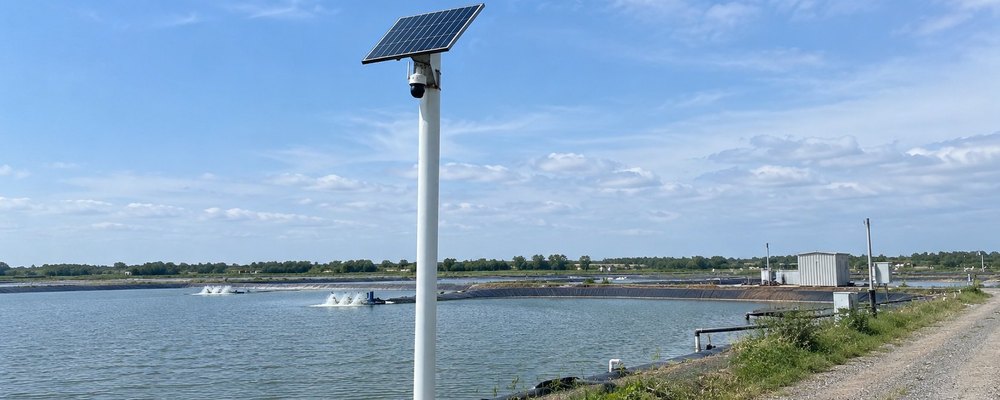
What the System Powers on a Pond Bank
The list is deliberately short. A camera and, where the bank has no line of sight back to the office, a router. The same layout covers a fish farm with a single pond and a group of ponds along one bank. Water-side machinery is a separate question and is not part of this system.
| Camera at the feed shed or gate | 5–10 W while tracking |
| Second camera on the bank | 3–8 W |
| 4G router or wireless bridge | 5–8 W, only where the bank needs its own link |
| Pond aerators and pumps | Not powered by this system. They draw far more than the output limit and run on the farm supply. |
| Total allowed at one post | under 60 W (5 A at DC 12V), whatever the panel size |
| Connector | 5.5 × 2.1 mm DC plug (DC5521) on the output leads. 5.5 × 2.5 mm will not fit, so check the camera plug before ordering. |
Camera counts quoted for a pond are a worked example for low-power cameras. The binding limit is the combined continuous draw of the equipment on the post, which must stay under 60 W.
One Solar System, Configured for the Actual Camera Load
A pond bank usually needs one camera at the feed shed and, where there is no line of sight back to the office, a router. Both can share one standard system: panel, battery and outputs on the same post. They share it only when the combined continuous draw, the cable distances, the voltage and the connectors all suit the system, and the loads column is where that check starts.
Total continuous load must not exceed 60 W (5 A at DC 12V). Recommended load depends on the actual draw of your cameras and router. Send us the models and we will check it for you.
One Camera, Several Camera Views, or a Bank With No Wall
One pond, one camera
YO-M8040: this 80W solar power system carries an 80W panel and a 40Ah battery, 10.0 kg, which one person can set on a bank post. It covers the feed shed or the gate where feed and equipment are stored, with a router on the same post if the bank needs a link.
Multiple Cameras Along One Pond Bank
YO-P12060: a 120W solar power system with a 60Ah battery for installations where two or more camera views are needed along the same pond bank. Cameras can share the system only when their combined continuous power demand stays within the 60 W output limit and the cable distances, voltage requirements and connectors are suitable. The number of ponds covered depends on camera placement, field of view and network connectivity. A separate system may be more practical when camera locations are far apart.
Embankment post, nothing to bolt to
YO-P12060-T: the same power core on a pole-mounted solar power system bracket, for a bank where the only structure is the post itself. Where that post also has to carry the link back to the office, the router goes on the same bracket and its draw is counted with the cameras.
Fixing to a Bank Without Going Into the Water
Base above the high water mark
The post goes on the bank, behind the edge, not on the slope down to the water. A base that sits in splash zone loses its footing over a few seasons. Keep the battery box at waist height on the post so it stays clear of spray and of anyone wading past.
Aim along the bank, not at open water
A camera pointed across open water records glare and ripples. Point it along the bank at the feed shed, the gate and the mooring, which is where boats, feed sacks and people actually appear, and where anything missing is noticed the next morning.
Cable stays on dry ground
No cable goes into the pond. Run it along the bank posts and clip it to the fence line if there is one. Any joint sits above the bank line, inside a sealed box, not in a splice lying on the grass where a mower or a net will find it.
Aquaculture-Specific Installation Considerations
Humidity and Water Spray
Aquaculture sites can expose outdoor equipment to high humidity, condensation and water spray from nearby aerators. These conditions should be considered when selecting the enclosure, cable connections and mounting position. Our housings carry an IP65 rating, which covers dust and water jets rather than condensation, salt-laden air or immersion.
Where possible, install the system outside the direct spray zone and keep cable joints protected in suitable sealed enclosures. For coastal sites, check the corrosion resistance of the mounting hardware before installation.
Actual service life depends on the equipment specifications, site conditions and maintenance practices.
Night-Time Aeration and Camera Placement
Aeration usually runs at night from the farm supply, so the pond is loud and moving at 2 a.m. while the camera is running on its own battery. That is the window a camera is most useful for, so point it along the bank at the feed shed and the mooring rather than at the middle of the water.
Monitoring Multiple Ponds From One Bank
A single system may cover cameras on more than one pond where the positions, the cable distances and the combined draw all work. Check the total continuous load against the 60 W output limit, and check that each camera has a workable link back before you plan around it. Where ponds sit on separate banks some distance apart, separate systems are usually more practical than one long cable run.
Asked by Fish Farm and Pond Operators
Can the same system run the pond aerators?
Where on the bank should the post go?
Can one system cover cameras on two ponds?
What plug do pond cameras need?
The Same Hardware on a Different Kind of Site
Water and distance are the two problems this page solves, and both show up on other sites. A reservoir or a pump house is a different case because the equipment being watched is the machinery itself rather than the water, which is a separate application in its own right. A farm that also watches a gate and a barn is described in solar power for farm security cameras, and a block of rows brings its own constraints on post height and spray, which is solar power for orchard and vineyard monitoring. A bank with no line of sight back to the office usually needs the link more than the power, which is the case the solar powered 4g router page covers.
Where the water sits under cover rather than in open ponds, the condensation and shading notes under solar power for greenhouse sensors replace the open-water ones.
Where the pond edge happens to be the high ground for the district link, the tower-site notes under solar power for rural internet towers read across.
The method for working out panel size from a camera label, step by step, is in panel sizing for pond cameras. What ships in the box and how long it takes are on shipping and lead time.
Tell Us How Many Ponds and How Many Cameras
Send the camera model and its rated draw, the number of ponds on the bank, and whether a router shares the post. We will confirm one standard model and quote it FOB China, typically replying within 24 hours. Payment is 100% in advance by T/T and typical lead time is about 15 days from receipt of payment. Minimum order is 2 pcs.