
Solar Power for Greenhouse Monitoring
A greenhouse range sits where the light is best, which is usually the one place on the farm with no building to tap and no interest in a trench. Solar power for greenhouse monitoring puts the camera, the climate gateway and the link on their own pole, so a house can be watched from the day it is clad. The loads here are small; the difficulty is placement, because the structure that makes the plants grow is also the structure that shades a panel.
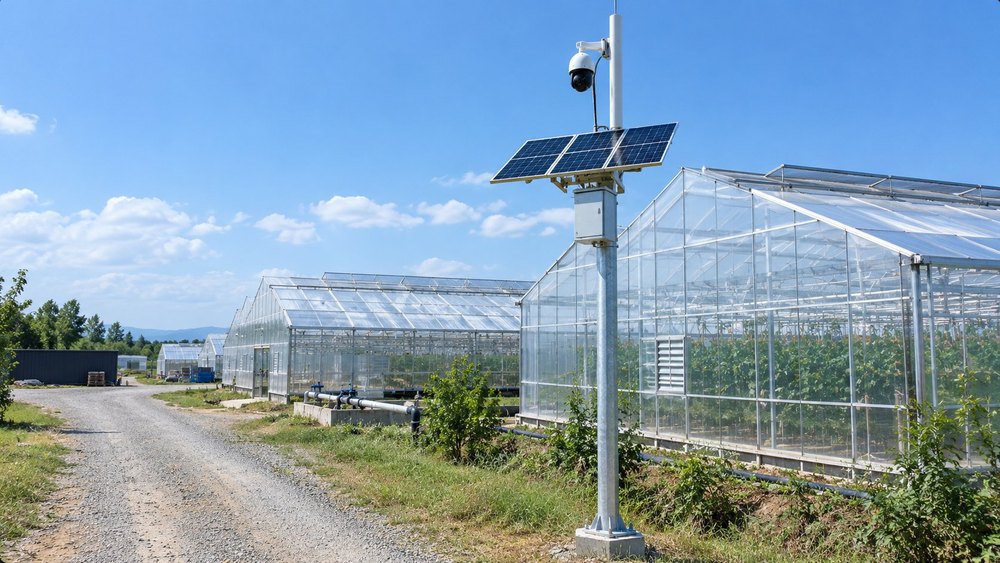
The Best Light for the Crop Is the Worst Place for a Cable
Two things are true of almost every greenhouse range. It stands in open ground, often on the far side of the farm from the packhouse and the office, and it is built from materials chosen for light transmission rather than for holding conduit. Running mains out to the end of a range means a trench through a field that gets worked, crossed by irrigation lines, and dug up again whenever the houses are reconfigured.
Inside the house the picture does not improve. A wet, warm, frequently washed environment is a poor home for sockets and junction boxes, and every device added indoors competes with the crop for the same roof area. That is why the practical pattern on working ranges is a self-contained point on the perimeter track: one pole, panel above it, camera looking along the gutter line, gateway and link inside the same enclosure.
What a Greenhouse Monitoring Point Actually Draws
Monitoring is a light job compared with running the house. The task is to keep it that way, and to know exactly which loads belong on this system and which never will.
| Device at the point | Typical continuous draw | Watch for |
|---|---|---|
| Camera on the range or in the house | 5–10 W typical | Peaks when IR is lit and the lens is moving |
| Climate or soil sensor gateway | 1–3 W typical | Small, but it reports all night |
| Wireless bridge or DC 12V router | ≈8 W typical | Present every hour of the year |
| Door contact, relay, small accessory | 1–3 W typical | Easy to leave off the list |
Reference values, not specifications. The label on your own equipment decides. Total continuous load at one point must not exceed 60 W (5 A at DC 12V).
One Point, One Self-Contained System
Everything at a coverage point is powered from one standard system: panel, battery and outputs on the same pole or wall. The diagram shows how the pieces connect; the loads column is where your camera and router draw sits.
Total continuous load must not exceed 60 W (5 A at DC 12V). Recommended load depends on the actual draw of your cameras and router. Send us the models and we will check it for you.
Three Greenhouse Situations, Three Standard Sizes
One camera at the end of a house
YO-M8040: an 80W solar power system with a 40 Ah battery. Enough for a single camera in the 5–10 W range with a sensor gateway beside it, which covers a door, a vent bank or the end wall of one house.
Camera, gateway and a link to the office
YO-P12060: a 120W solar power system with a 60 Ah battery. The usual range configuration, because a monitoring point that has to send video off the farm carries the link load every hour, not just when somebody is watching.
Shaded siting, heavier list, long grey spells
YO-P12060-T puts the same power core on a heavy triangle bracket where there is no wall to fix to, which is the normal case beside a film house. YO-P240120 when the panel has to sit at a less than ideal angle or the site sees long overcast weather and the point needs the 120 Ah reserve.
Siting a Point Around a Structure Built to Block Light
Panel outside, camera inside the range line
A panel behind film or glass is a panel running at a fraction of its rating, and a panel mounted inside a house also takes light from the crop. Keep the array on the perimeter track with a clear southern horizon, then run the camera cable back to the house it serves.
Battery box low, shaded and ventilated
The warmest air in a range is at the ridge, and a sealed box sitting there works harder than it needs to. Mount the enclosure at working height on the shaded side of the pole, clear of the house wall, so air moves past it and a technician can reach it without a ladder.
Cable entries that shed water
Where a cable leaves the pole and enters a house, form a drip loop and enter from below. Washdown water and condensation travel along a cable, and an entry gland facing upward is the usual reason a connection corrodes in its first season.
Four Things That Only Come Up on a Greenhouse Range
1. The building is the shade
On most sites the obstacle to a solar array is a tree or a neighbouring building. On a greenhouse range it is the client’s own structure, and it is long. A range running north to south puts a shadow across the track for part of every day, which is why the practical answer is often a pole on the outer track with the array above ridge height rather than a bracket on the house itself. Walk the site at the low-sun hours before fixing a position.
2. Heat belongs to the battery, not the camera
Cameras tolerate a warm house far better than the battery box does. The enclosure is sealed to IP65 against washdown and humidity, but sealing also means it cannot shed heat quickly, so placement matters more here than on an open site: shaded side of the pole, below the ridge line, air moving past it. Do not tuck the box into the warmest corner of the range because the cable run is shorter.
3. The crop changes the view three times a season
A camera set at chest height in an empty house films a floor. Six weeks later the same camera films the back of a canopy. On trellised crops the sight line is only valid for part of the cycle, so mount above the final crop height and check the framing at the stage that matters for the operator, not on the day of commissioning.
4. Monitoring power and growing power are separate budgets
It is worth saying plainly at the quotation stage, because it manages the expectation before the hardware arrives: this system powers the eyes and the sensors. The moment the conversation turns to running fans, lights or irrigation valves, the numbers belong to a completely different class of equipment.
A range that borders open field usually shares its monitoring layout with the wider farm, covered under solar power for farm security cameras. Where the crop is under cover but the perimeter is not, the outdoor points follow solar power for orchard security cameras, and a range beside a reservoir or a packhouse pond has the same wet-ground constraints as solar power for aquaculture cameras.
Asked by Growers and Range Installers
Can the same system run the fans, lights or irrigation valves?
Can the panel be mounted on or inside the house?
Is a sealed box alright in a wet, frequently washed house?
One system for the whole range, or one per house?
Send the Range, Get a Point-by-Point Plan
Tell us how many houses, how far the track runs and what you intend to monitor with. We will map it onto standard sizes and quote them FOB China. We are not the factory: we supply these standard systems, so if a point genuinely needs something else we will say so rather than invent a model.
Plan the points
Number of houses, track length, device list. We will come back with how many systems and which size for each point, typically within 24 hours.
Ask Us to Plan ItCheck the numbers
Panel, battery, output and bracket for every standard size, on the product pages, so you can check the load arithmetic yourself.
See the DataMinimum order 2 pcs · FOB China · Payment is 100% in advance, by T/T bank transfer · Standard models · Typical lead time ~15 days