
Solar Power for Substation and Plant Monitoring Cameras
A substation is the best-fenced site in the energy business, and it is still the one where every cable you add has to be justified to an electrical standard. Solar power for substation monitoring sidesteps that entirely: a freestanding pole with its own panel and battery watches the gate, the lanes and the corners, carries no metallic path into the compound, and leaves the yard’s own electrical regime completely untouched.
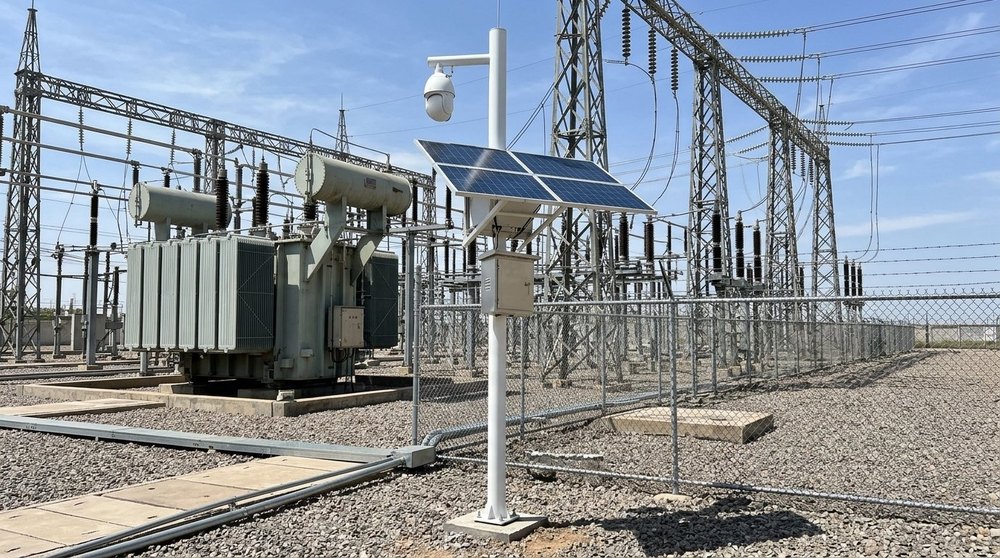
The Fence Already Exists. The Eyes Do Not.
Substations carry copper that leaves at night and transformer sites that sit unmanned between inspection rounds. The perimeter is real, but a fence only slows a visitor, and an incident inside a gravel yard is discovered by the next crew, not while it happens.
The reason the camera points go solar is not the usual one. Power exists at the site, but everything inside the fence belongs to an electrical regime with its own clearances, bonding rules and access discipline, and every new metallic run across the yard is a conversation with that regime. A self-contained point stands on its own foundation, carries no conductor between camera and yard, and leaves the station’s own design exactly as it was.
What a Substation Camera Point Actually Draws
Substation points are ordinary camera loads in extraordinary surroundings; the equipment list is short and the siting discipline is not.
| Device at the point | Typical continuous draw | Watch for |
|---|---|---|
| Camera at a gate or lane | 6–10 W typical | Runs around the clock, every day of the year |
| PTZ covering the compound | 8–12 W typical | Night viewing draws the most, and night is the point |
| Radio link to the control building | ≈8 W typical | The non-metallic path out of the yard |
| Second camera at an opposite corner | 6–10 W typical | Its own pole and system, not a shared run |
Reference values, not specifications. The label on your own equipment decides. Total continuous load at one point must not exceed 60 W (5 A at DC 12V).
One Point, One Self-Contained System
Everything at a coverage point is powered from one standard system: panel, battery and outputs on the same pole or wall. The diagram shows how the pieces connect; the loads column is where your camera and router draw sits.
Total continuous load must not exceed 60 W (5 A at DC 12V). Recommended load depends on the actual draw of your cameras and router. Send us the models and we will check it for you.
Three Yard Situations, Three Standard Sizes
A gate camera at a small distribution yard
YO-M8040: an 80W solar power system with a 40 Ah battery. Suits a small fenced yard with one gate, a weekly inspection round and a pole position with open sky over the compound.
A PTZ over a mid-size switchyard
YO-P12060: a 120W solar power system with a 60 Ah battery. The standard choice where one PTZ reads the lanes and the compound from a corner position, and the video leaves by radio to the control building.
Large yards and opposing corners
YO-P12060-T for the same power core on a heavy triangle bracket where the point stands exposed at the fence line, and YO-P240120 where the site is remote from the maintenance depot and each point has to hold a 120 Ah reserve.
Working Where Everything Is Live Until Proven Otherwise
Freestanding means freestanding
No bracket touches the fence, the gantries or the compound structures, and no conductor runs from the point into the yard. The pole stands on its own footing outside the equipment clearances, so the camera and the station share nothing but the view.
The station’s rules outrank the layout
Access discipline, clearances and bonding inside an electrical site are set by the operator and its contractors under their own standards, and the installation plan goes through them first. A solar point keeps that conversation short precisely because it adds nothing conductive to the yard.
The stone floor is part of the design
Yards are dressed in crushed rock for drainage and step potential, and the footing has to respect both. Set the foundation where it does not cut the dressed surface, keep the route to the pole along the yard edge, and leave the gravel exactly as the station built it.
Four Things That Only Come Up Inside the Fence
1. The point adds no conductor to the yard
The whole argument for a solar point here is subtraction: no trench across the gravel, no metallic path between the camera and the compound, no new bonding question. Everything the point carries arrives on one pole and leaves by radio. On most sites that is a convenience; on a substation it is the difference between an afternoon’s work and a design review.
2. Copper leaves at night here too
Ground wire, earthing strap and cable loots are a known problem at yards between inspection rounds, and the loss is found by the next crew, days after the visit. That is the case for watching the lanes rather than only the gate, and for a reserve sized to the inspection interval, because the point has to be recording through exactly the stretch when nobody is there.
3. One pole reads the whole compound
A substation is open ground with long sight lines, which makes it the easiest site of the twenty to cover from a single corner. The camera plan usually fails in the opposite direction: too many points, each justifying itself. Work from one corner position that reads the gate, the lanes and the equipment rows, and add a second point only where a real blind corner remains.
4. Night is the working shift for this camera
Between inspection rounds the yard belongs to nobody, and the incidents that matter happen after dark. That inverts the usual daylight bias of solar sizing: the load is continuous anyway, but the night matters proportionally more, which is why the reserve, the radio link and the camera’s night performance all carry more weight here than on a daytime site.
Where the watched compound holds process equipment instead of switch racks, the pad notes under solar power for well pad camera points cover the same one-point logic. Where the yard boundary meets the site fence line, the gate and perimeter layout under solar power for perimeter fence cameras reads across. And where copper theft is the driving case rather than the background, the stockpile and looting notes under solar power for mine site camera points apply unchanged.
Where the unmanned yard sits inside an electrical or utility site, the freestanding-pole layout under solar power for water pump station covers the camera point at the fence.
Asked by Operators and Their Contractors
Can the pole go inside the compound or must it stay at the fence?
Does the camera need the station’s power supply?
How many points does a yard need?
What happens during an outage or a switching operation?
Send the Yard Layout, Get the Honest Point Count
Tell us the yard size, the gates and the inspection interval. We will map the points onto standard sizes and quote FOB China. We are not the factory: we supply these standard systems, so where a site genuinely needs something else we will say so.
Plan the points
Yard layout, gates, inspection round. We will come back with how many systems and which size for each, typically within 24 hours.
Ask Us to Plan ItCheck the numbers
Panel, battery, output and bracket for every standard size, on the product pages, so you can run the night-shift arithmetic yourself.
See the DataMinimum order 2 pcs · FOB China · Payment is 100% in advance, by T/T bank transfer · Standard models · Typical lead time ~15 days