
Solar Power for Water Pump Station Cameras
A pump station is unmanned, fenced, often sited down by the water it moves, and visited on a meter round rather than a schedule. Solar power for water pump station cameras puts a watching eye on that fence line with a pole, a panel and a reserve sized to the round, and it keeps the pumps entirely out of the conversation: the system carries the camera and its radio link, and nothing else.
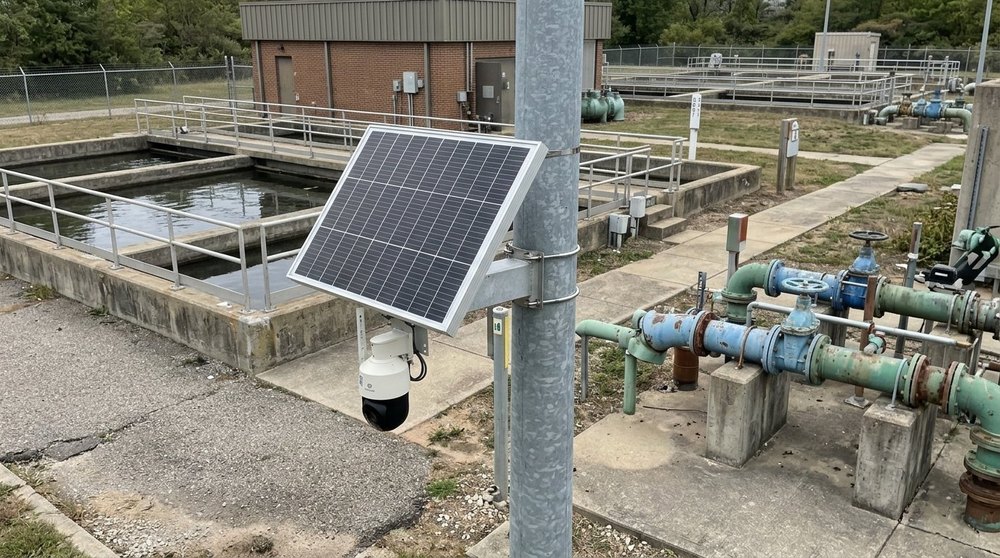
The Pump Has Its Power. The Camera Did Not.
A water or wastewater station runs its pumps from a dedicated supply that predates every other decision on site, and nobody touches it, for good reason. The camera question arrives years later, at a gate nobody watches, beside basins nobody visits between rounds.
Trenching to that gate crosses exactly the ground a utility keeps graded and clear, and the load it would serve is a camera and a radio link, single-digit watts. A self-contained point answers it in proportion: one pole outside the work zones, its own panel and reserve, and a radio link back to the office that does not open the station’s own systems at all.
What a Pump Station Camera Point Actually Draws
The load list is the simplest of the twenty site types in this series; the siting is the part that needs care.
| Device at the point | Typical continuous draw | Watch for |
|---|---|---|
| Camera at a gate or walkway | 6–10 W typical | Runs around the clock between rounds |
| PTZ over the manifolds | 8–12 W typical | Night and movement raise the draw |
| Radio link to the utility office | ≈8 W typical | The path back to the people who need the footage |
| Telemetry or sensor node nearby | 2–5 W typical | Small, permanent and easy to forget in the total |
Reference values, not specifications. The label on your own equipment decides. Total continuous load at one point must not exceed 60 W (5 A at DC 12V).
One Point, One Self-Contained System
Everything at a coverage point is powered from one standard system: panel, battery and outputs on the same pole or wall. The diagram shows how the pieces connect; the loads column is where your camera and router draw sits.
Total continuous load must not exceed 60 W (5 A at DC 12V). Recommended load depends on the actual draw of your cameras and router. Send us the models and we will check it for you.
Three Station Situations, Three Standard Sizes
A gate camera on a weekly meter round
YO-M8040: an 80W solar power system with a 40 Ah battery. Suits a small unmanned station with one gate, a weekly visit and open sky above the fence line.
A PTZ over the basins and manifolds
YO-P12060: a 120W solar power system with a 60 Ah battery. The standard choice where one PTZ reads the walkways, the valve manifolds and the gate from a corner of the yard, with the video leaving by radio.
A low-lying site that rides out the missed round
YO-P12060-T for the same power core on a heavy triangle bracket where the point stands in open wind, and YO-P240120 where the round is fortnightly or the road floods, and the point has to hold a 120 Ah reserve until the next one.
Pump stations rarely sit alone: where several serve one water main or river intake, power planning along a corridor sizes the stations as one series rather than separate builds.
Building on Ground the Water Chose
Height above the water, not just above the fence
Pump stations sit low because the water does. Site the pole on the highest ground the yard offers, well back from the channel and the flood line, and the point keeps working through the weather that made the camera worth installing.
Out of the work zones
The station’s own crews work around the wet wells, the manifolds and the crane paths. A freestanding pole at the yard edge, away from those zones and from anything that gets lifted, keeps the point out of every future maintenance story.
Sealed hardware in a damp yard
Water sites run humid, splashed and sometimes misty. Keep the enclosure sealed, the connectors rated for it and the cabling in conduit against the pole, and the point behaves like the station’s other outdoor hardware instead of like a visitor.
Four Things That Only Come Up at a Pump Station
1. The system does not run the pump, and never will
This is the first question every utility asks, so it deserves the first answer: no. The pumps run on their own dedicated supply, sized and protected by people whose job that is, and a camera system that reached toward that supply would be a liability in both directions. What the standard system carries is the camera, the radio link and small accessories, at a point where that is the whole requirement. Knowing where the boundary is, and saying so up front, is why the camera point gets approved at all.
2. The meter round is the entire maintenance plan
Unmanned stations are visited when the route says so, and a flooded road or a locked gate stretches that interval without asking. The reserve is therefore sized from the longest realistic gap between rounds, not from the calendar the utility prints. A point that rides a missed visit without going dark is a point that gets trusted, and trust is what keeps these installations in the budget.
3. The water table shapes the foundation
Ground that sits near water is ground that shifts, floods and stays damp all year. The footing goes deeper than the site’s dry-weather appearance suggests, the pole stands back from the basins and the drainage lines, and the array sits high enough to clear both the fence and the morning mist off the water. This is ordinary engineering, but it is the engineering that decides whether the point is still upright in year three.
4. Vandalism finds unmanned yards first
Between rounds, a pump station is an empty fenced yard with copper inside it, and the incidents run from graffiti to stripped cable. The camera point exists because the loss is discovered late, and the footage has to survive the same stretch the station does. That is why the reserve and the link are treated as the core of the design rather than as accessories around a camera.
Where the utility also runs an electrical yard, the freestanding-pole layout under solar power for substation cameras covers the same no-conductor logic. Where the station fence meets a longer boundary, the gate and line layout under solar power for perimeter fence cameras reads across. And where the link back to the office rides a mast of its own, the site notes under solar power for rural tower sites apply to that pole.
Asked by Utilities and Their Contractors
Can this system run the pumps?
What happens if a visit is missed?
Where should the pole stand in a small yard?
Does the camera interfere with the station’s telemetry?
Send the Station List, Get the Sizes and the Reserve
Tell us what each point watches and the longest gap on the route. We will map them onto standard sizes and quote FOB China. We are not the factory: we supply these standard systems, so where a site genuinely needs something else we will say so.
Plan the points
Stations, device list, meter round. We will come back with how many systems and which size for each, typically within 24 hours.
Ask Us to Plan ItCheck the numbers
Panel, battery, output and bracket for every standard size, on the product pages, so you can run the between-rounds arithmetic yourself.
See the DataMinimum order 2 pcs · FOB China · Payment is 100% in advance, by T/T bank transfer · Standard models · Typical lead time ~15 days