
Solar Power for Oil and Gas Well Pad Cameras
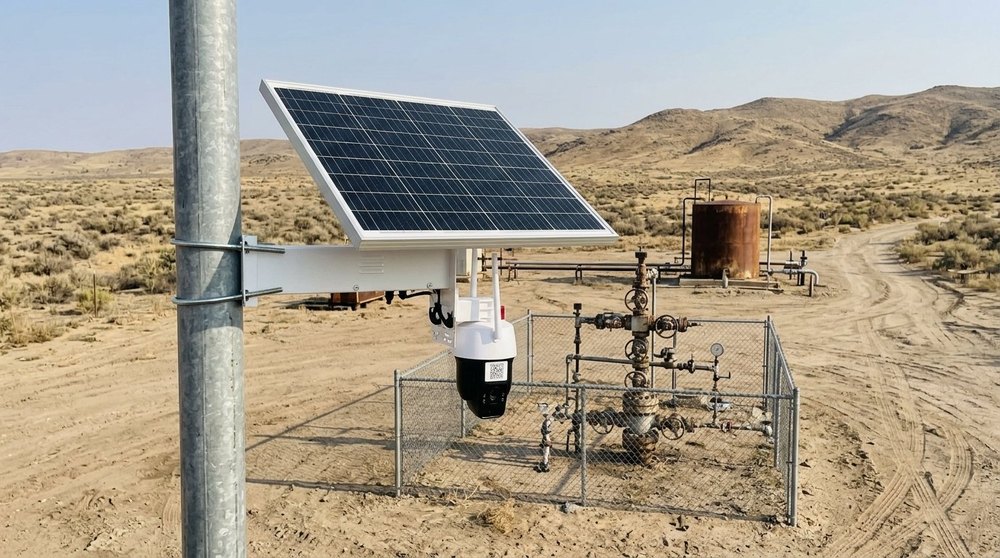
A well pad is small, fenced, fenced for a reason and visited on a schedule measured in days, not hours. Running power to each pad means trenching across lease roads for a load a light bulb would beat. Solar power for oil and gas well pad cameras keeps the point on its own pole instead, sized to ride the whole interval between pumper rounds, and the same arithmetic carries the valve and right-of-way points where off grid solar power for pipeline monitoring has to work without a visit at all.
The Pad Runs on Zero Hands Already
A well pad produces around the clock and is touched perhaps once or twice a week. Power follows people, and the pad has none: the tank battery, the separator and the injection skid carry their own supply arrangements, and the fence line has nothing between it and the nearest cable except lease road.
That emptiness is exactly why the camera question exists. A pad holds brass, copper, gauges and tubing that resell, behind a fence that is designed to slow a walk-through rather than stop one. A camera point answers it with the pad’s own logic: nothing to trench, nothing to fuel, and a reserve sized to the pumper’s round so the point never depends on an unscheduled visit.
What a Well Pad Camera Point Actually Draws
Pad camera points are single-digit loads with long unattended stretches; the sizing question is the interval, not the equipment.
| Device at the point | Typical continuous draw | Watch for |
|---|---|---|
| Camera at the wellhead fence | 6–10 W typical | Runs every hour the pad runs, which is all of them |
| PTZ at a tank battery | 8–12 W typical | Movement draws more; night is when the point matters |
| Radio link to the field office | ≈8 W typical | Often the only path off the pad |
| Second camera or right-of-way node | 5–10 W typical | A different pole gets its own system; this line is one point |
Reference values, not specifications. The label on your own equipment decides. Total continuous load at one point must not exceed 60 W (5 A at DC 12V).
One Point, One Self-Contained System
Everything at a coverage point is powered from one standard system: panel, battery and outputs on the same pole or wall. The diagram shows how the pieces connect; the loads column is where your camera and router draw sits.
Total continuous load must not exceed 60 W (5 A at DC 12V). Recommended load depends on the actual draw of your cameras and router. Send us the models and we will check it for you.
Three Pad Situations, Three Standard Sizes
A wellhead camera on a short pumper round
YO-M8040: an 80W solar power system with a 40 Ah battery. Suits a fenced pad the pumper passes weekly, one fixed camera on the gate side and open desert sky above the array.
A tank battery that is watched, not visited
YO-P12060: a 120W solar power system with a 60 Ah battery. The standard choice where a PTZ covers the tanks and the loadout side, and the video leaves by radio to the field office.
A remote pad or right-of-way point
YO-P12060-T for the same power core on a heavy triangle bracket where the point stands in open wind, and YO-P240120 where the visit interval stretches past two weeks and the point has to hold a 120 Ah reserve between rounds.
Building Around a Pad That Is Already Fenced
Outside the fence, in the operator’s sight
The fence is the operator’s work area, and adding hardware inside it complicates every future service call. Set the pole outside the compound where the lease road reaches, high enough that the camera reads the whole pad over the fence line.
One pole that sees the whole pad
A pad is small: wellhead, header, separator, tanks. One camera at the right corner covers most of it, which is why pad points rarely justify a second one. Confirm the sight lines before the footing, and resist adding a second system where one honest angle answers.
Sealed, staked and out of the rut line
Lease roads grow ruts and the vacuum truck will one day cut the corner. Keep the pole clear of the tracked line, the enclosure sealed against dust, and cabling in conduit against the pole where a hose or a ladder cannot find it.
Four Things That Only Come Up on a Well Pad
1. The pumper’s round is the service schedule
Pad visits follow the gauge run, and the gap between runs is the real specification for the reserve. A pad seen weekly needs less spare capacity than a valve point seen monthly, and a design that quietly assumes somebody will drop by does not survive a washed-out lease road. Size the reserve from the longest interval the route actually produces, then let the visit be a check rather than a rescue.
2. Brass and copper are the target list
What disappears from remote pads is small, portable and made of metal: gauges, tubing, valve handles, ground wire. The camera exists because the loss is discovered at the next visit, days after it happened. That argues for the reserve and the radio link being treated as first-order equipment, because a point that blinks silently is a point whose footage ends when it matters.
3. One pad, one point, one honest angle
Multi-camera projects grow on big sites where corners hide corners. A pad has four corners and a fence, and the common mistake is doubling hardware to watch hardware. Where a second location genuinely exists, the tank battery or the gate, it usually gets its own pole and its own system, because sharing a long low-voltage run between points costs more than the second array.
4. The right-of-way is a second network
Valve points, crossing markers and line breaks along a right-of-way are far from any pad and any road, which makes them the purest off-grid case in the field. The loads are smaller, the visits rarer and the siting simpler, and the same standard systems carry them. Treating the right-of-way as its own small network, point by point, keeps the arithmetic honest instead of stretching one pad’s design over ten miles of line.
Where the watched ground is a working face rather than a fenced pad, the moving-point notes under solar power for mining site cameras read across. Where the pad line meets the lease boundary, the gate and fence layout under solar power for perimeter fence cameras covers it. And where the field’s comms ride a mast of their own, the site notes under solar power for rural internet towers apply to that pole.
Where the fenced compound holds switch racks rather than process piping, the yard notes under solar power for substation monitoring cover the one-point-sees-all case.
Where the unmanned yard belongs to process equipment, the pad notes under solar power for water pump station cameras read across to the utility side.
Asked by Operators and Lease Hands
Can one point cover the whole pad?
How is the reserve sized when nobody visits for weeks?
Can the point go inside the fence?
What about points along the right-of-way?
Send the Pad List, Get the Sizes and the Reserve
Tell us what each point watches and the longest gap between visits on the route. We will map them onto standard sizes and quote FOB China. We are not the factory: we supply these standard systems, so where a site genuinely needs something else we will say so.
Plan the points
Pads, device list, pumper round. We will come back with how many systems and which size for each, typically within 24 hours.
Ask Us to Plan ItCheck the numbers
Panel, battery, output and bracket for every standard size, on the product pages, so you can run the between-rounds arithmetic yourself.
See the DataMinimum order 2 pcs · FOB China · Payment is 100% in advance, by T/T bank transfer · Standard models · Typical lead time ~15 days