
Solar Power for Mining Site Cameras
A mine is the one site where the ground itself moves: benches advance, haul roads relocate and last year’s camera position is this year’s muck pile. Solar power for mining site cameras answers that with points that are self-contained by design, so the watching moves with the working face instead of being abandoned with it.
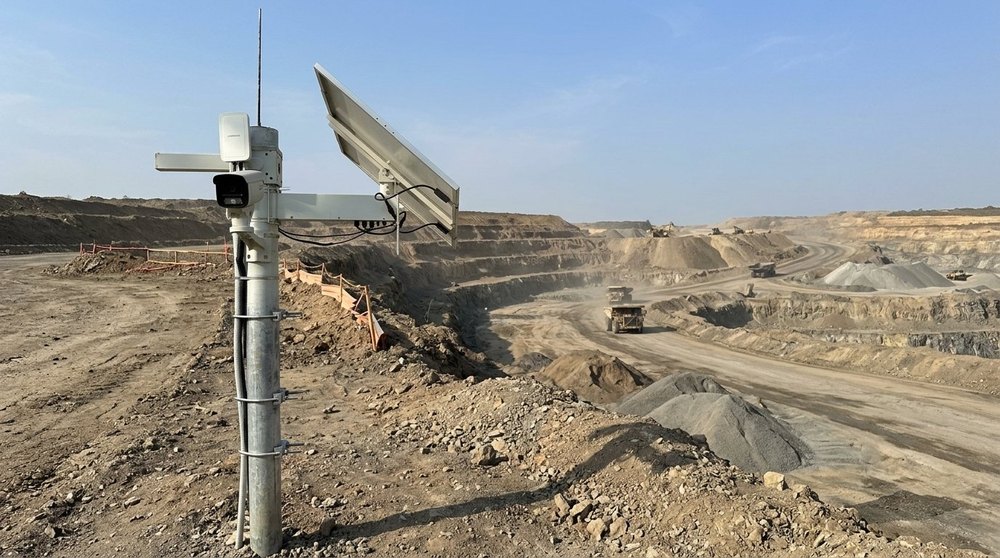
The Working Face Never Waits for a Cable
Mine sites are powered where the fixed plant is, and nowhere else. A crusher, a workshop and the office carry the grid or the generators; everything out on the benches runs on vehicles and radios. Extending power to a camera position that will be redundant in six months is a spend no mine plan survives.
Yet the benches are exactly where the camera questions live: haul-road interaction points, the pit exit, stockpiles and the gates where every vehicle passes twice. A self-contained point fits that pattern, because the array and battery arrive on the same truck as the pole, stand up in an afternoon and move to the next bench when the face moves.
What a Mine Camera Point Actually Draws
Mine camera points are small loads with hard surroundings: the equipment list is ordinary, the conditions are not.
| Device at the point | Typical continuous draw | Watch for |
|---|---|---|
| Fixed camera on a bench | 6–10 W typical | Runs around the clock, every day of the year |
| PTZ with wiper at an interaction point | 8–12 W typical | The wiper motor is small but frequent on dusty roads |
| Radio link to the site office | ≈8 W typical | Often the only path off the bench |
| Second camera or mesh node | 5–10 W typical | Each added unit is a permanent line in the budget |
Reference values, not specifications. The label on your own equipment decides. Total continuous load at one point must not exceed 60 W (5 A at DC 12V).
One Point, One Self-Contained System
Everything at a coverage point is powered from one standard system: panel, battery and outputs on the same pole or wall. The diagram shows how the pieces connect; the loads column is where your camera and router draw sits.
Total continuous load must not exceed 60 W (5 A at DC 12V). Recommended load depends on the actual draw of your cameras and router. Send us the models and we will check it for you.
Three Mine Situations, Three Standard Sizes
A fixed camera at the pit exit
YO-M8040: an 80W solar power system with a 40 Ah battery. Suits a fixed camera on a road the site service vehicles pass daily, where the visit is easy and the array has open sky over the bench.
A PTZ at a haul-road interaction point
YO-P12060: a 120W solar power system with a 60 Ah battery. The standard choice where a PTZ with a wiper watches an interaction point and the video leaves by radio to the office.
A remote gate or stockpile that must not blink
YO-P12060-T for the same power core on a heavy triangle bracket where the point stands exposed on a bench crest, and YO-P240120 where the gate sits far from the workshop and the point has to hold a 120 Ah reserve between service rounds.
Building on a Site That Redraws Itself
Stand where the bench will be
The point outlives the bench it starts on, so the foundation question is who owns the spot next quarter. Set the pole back from the crest and the blast clearance line, on ground the mine plan does not dig, and the point survives its own first relocation.
The service road is the maintenance plan
Everything on a mine is maintained from a vehicle, so a point the ute cannot reach is a point that does not get maintained. Site the pole within reach of an existing service road, and let panel cleaning and camera checks ride the rounds the site already runs.
Sealed, bonded and nothing loose
Dust works into every unsealed gap, and mine hardware takes knocks the average site never sees. Keep the enclosure sealed and latched, the cabling in conduit against the pole, and any earthing and bonding to the standard the site’s own electrical rules set for that area.
Four Things That Only Come Up in a Pit
1. The point is planned to move
On most sites relocation is a failure; on a mine it is the plan. Benches advance, roads re-route and stockpiles grow in new corners, so the camera positions move with the working face. A self-contained point makes that a crane lift and a new footing instead of a decommissioned cable run, which is the quiet reason mines buy standard units rather than extend power one position at a time.
2. Dust writes the maintenance schedule
A haul road dusts the panel every shift, and a dusty panel is a smaller array whatever its nameplate says. Tilt the array steeply enough for dust and rain to shed, put the point where the service round already passes, and treat panel cleaning as part of the same visit that checks the camera. The array to specify is the one that carries the load on a dusty week, not on a clean one.
3. The camera is a safety eye before it is a security eye
Interaction points on haul roads are watched because that is where near-misses happen, and the footage feeds how the site runs its roads. That matters for siting: the camera goes where the sight lines of the road actually are, not where the fence is weakest. Security at gates and stockpiles still matters, but the haul-road view usually decides where the point stands.
4. Small loads are the easiest ones to take off the fuel run
Every generator-fed point on a mine costs a fuel delivery, a service visit and an excuse when the truck cannot get through. A camera point is small enough that a standard system carries it with no fuel, no exhaust and no reason to skip the visit. The comparison is not solar against the grid, it is solar against a generator run nobody wants to schedule.
Where the watched line is the concession fence rather than the working face, the layout under solar power for perimeter fence cameras covers the gate and boundary points. Where the mine site borrows the construction phase’s temporary-watch pattern, the siting notes under solar power for construction sites read across. And where the link back to the office rides a small mast of its own, the site notes under solar power for rural tower sites apply to that pole.
Where extraction settles onto fixed pads instead of a moving face, the pad notes under solar power for oil and gas well pad cameras take over the sizing.
Asked by Mine Electrical and HSE Teams
Can the point be relocated when the bench moves?
How does dust affect the array?
Does the equipment need special ratings for the pit?
Solar or another generator run?
Send the Positions, Get the Sizes That Can Move
Tell us what each point watches, how the service rounds run and how soon the first relocation lands. We will map them onto standard sizes and quote FOB China. We are not the factory: we supply these standard systems, so where a site genuinely needs something else we will say so.
Plan the points
Positions, device list, service round. We will come back with how many systems and which size for each, typically within 24 hours.
Ask Us to Plan ItCheck the numbers
Panel, battery, output and bracket for every standard size, on the product pages, so you can run the dusty-week arithmetic yourself.
See the DataMinimum order 2 pcs · FOB China · Payment is 100% in advance, by T/T bank transfer · Standard models · Typical lead time ~15 days