
Solar Power for National Park Cameras
A park camera point has to work in two seasons at once: the busy one, when entrances and overlooks are watched closely, and the closed one, when the roads shut, the staff thins out and nobody can reach the hardware for months. Solar power for national park cameras has to be sized for that second season, because a point that rides only through summer goes dark exactly when the winter patrols need it most.
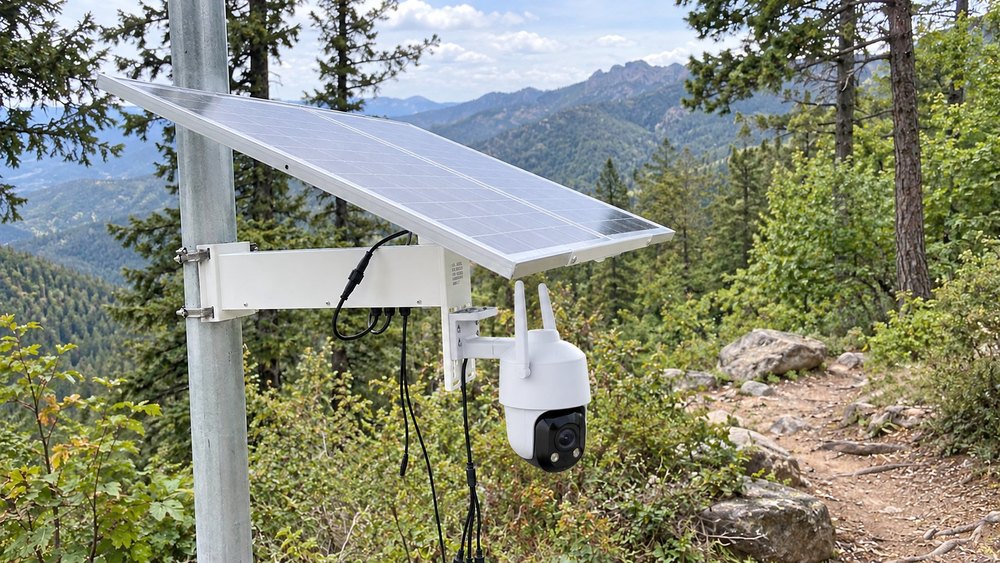
The Points Are Chosen by the View, Not the Utilities
Park camera networks are built where the work is: entrance stations, trail junctions, overlooks and the boundaries where vehicles leave the pavement. Those positions are fixed by sight lines and by where visitors actually pass, and none of them come with a socket nearby.
Trenching into protected ground is usually refused outright by the land agency, and even where it is allowed, a cable crossing a trail or a root zone becomes a maintenance liability the park did not have before. A self-contained point avoids the permission problem entirely: energy is collected at the pole, the only ground disturbance is one foundation, and the camera stands wherever the view says it should.
What a Park Camera Point Actually Draws
Park hardware is ordinary security equipment; what makes the point unusual is the calendar, not the load.
| Device at the point | Typical continuous draw | Watch for |
|---|---|---|
| Entrance or trail-junction camera | 6–10 W typical | Runs around the clock, including the closed season |
| PTZ head at an overlook, with heater if fitted | 3–8 W typical | Heating draws on cold nights, when solar input is zero |
| Radio link to the ranger station | ≈8 W typical | Always on, and often the only path off the point |
| Sensor or counting node at the same point | 2–5 W typical | Small on its own, easy to forget in the total |
Reference values, not specifications. The label on your own equipment decides. Total continuous load at one point must not exceed 60 W (5 A at DC 12V).
One Point, One Self-Contained System
Everything at a coverage point is powered from one standard system: panel, battery and outputs on the same pole or wall. The diagram shows how the pieces connect; the loads column is where your camera and router draw sits.
Total continuous load must not exceed 60 W (5 A at DC 12V). Recommended load depends on the actual draw of your cameras and router. Send us the models and we will check it for you.
Three Park Situations, Three Standard Sizes
A fixed camera at an entrance station
YO-M8040: an 80W solar power system with a 40 Ah battery. Suits a fixed camera at a staffed or gated entrance, where the road reaches the point, a visit is quick, and the array has open sky over the car park.
A PTZ at an overlook with a radio link
YO-P12060: a 120W solar power system with a 60 Ah battery. The standard choice for a viewpoint or trail junction, where the video leaves by radio and the point stands in the open well above the trail.
A remote point that must ride out the closed season
YO-P12060-T for the same power core on a heavy triangle bracket where the mast stands in open wind, and YO-P240120 where the roads close for winter and the point has to hold a 120 Ah reserve until the first service visit of spring.
Building Inside Rules the Park Wrote Before You Arrived
One foundation, not a trench
The fewer permissions a point needs, the more likely it gets built. A single footing for a mast keeps the ground disturbance to one small square and leaves the trail, the root zones and the drainage alone, which is usually the difference between an approved drawing and a refused one.
Hardware the public can reach is hardware the public will touch
Anything near a trail gets climbed on, leaned against and photographed. Mount the enclosure and the connectors at pole height, use fasteners that need a real tool, and keep cabling inside conduit so a curious hand finds nothing loose.
Plan the service visit around the closure calendar
Park access is not yours to schedule. Fit the point so the annual check rides an existing trip the rangers already make, keep connectors readable from the ground, and leave enough reserve that a missed autumn visit does not take the camera down in December.
Four Things That Only Come Up Inside a Park
1. Size for the closed season, not the visitor season
The busy months are also the sunny ones, and any reasonable array keeps up with them. The hard arithmetic is the opposite end of the calendar: the roads shut, the staff is minimal, and the camera is expected to keep recording with nobody checking it for weeks. Work the reserve and the array from the longest stretch the point must survive without a visit, and treat the visitor season as margin rather than as the design case.
2. Wildlife tests everything below head height
A park is full of animals that chew, rub, scratch and burrow, and they work through the seasons methodically. Anything a standard kit leaves exposed at animal height will eventually be found and worked on. Route cable in metal conduit, keep terminations inside the enclosure rather than on the pole, and leave the ground-level half of the point as short and as hard as possible.
3. The point must not become the attraction
A camera pole at a scenic overlook draws exactly the attention the scenery draws. Signage, mounting height and a neat, professional finish all matter here: a tidy pole with visible purpose gets left alone, and a messy one collects rope, stickers and climbing attempts. This is one of the rare sites where the appearance of the hardware is a maintenance question, not a cosmetic one.
4. Heritage and habitat rules outrank the installation
Park land usually carries restrictions ordinary sites never see: no digging near root zones, no fixing to historic structures, no cutting sight lines through vegetation. All of those push the design toward a freestanding mast and away from anything that attaches to the park itself. Check the restrictions before the layout, because they decide the mounting before the budget does.
Where a park boundary runs along a road corridor, the layout ends up close to the one described under solar power for highway traffic camera, and where the watched line is a fence rather than a trail, the point design follows solar power for border fence camera. Ridge points inside forested park land are covered under solar power for forest fire watch camera.
Where the park boundary includes shoreline or an offshore island, the salt, spray and landing notes under solar power for island and coastal sites take over from the inland ones.
Asked by Park Operators and Their Contractors
Can one system carry the camera through a whole winter?
Can we attach the panel to an existing tower or building?
What stops visitors from interfering with the equipment?
Does the system need a visit during the closed season?
Send the Points, Get the Sizes and the Reserve
Tell us where the points stand, what each has to watch and how long the access season lasts. We will map them onto standard sizes and quote FOB China. We are not the factory: we supply these standard systems, so where a site genuinely needs something else we will say so.
Plan the points
Number of points, device list, closure season. We will come back with how many systems and which size for each, typically within 24 hours.
Ask Us to Plan ItCheck the numbers
Panel, battery, output and bracket for every standard size, on the product pages, so you can run the closed-season arithmetic yourself.
See the DataMinimum order 2 pcs · FOB China · Payment is 100% in advance, by T/T bank transfer · Standard models · Typical lead time ~15 days