
Solar Power for Border and Fence Line Cameras
A fence line is the longest cable run a site ever asks for, and the one place where a power point almost never exists. Solar power for border fence cameras solves the part that costs the most money: getting electricity to a gate, a corner or a kilometre of perimeter that the grid never reached. Each standard unit is a complete pole-mounted package, so the camera goes up where the fence is watched rather than where the nearest socket happens to be.
Distance Is the Problem, Not the Camera
The camera at a fence gate is rarely complicated. What makes perimeter sites expensive is everything between the camera and the last place with power: the trench, the duct, the joint boxes, the inspection pits and the fact that a perimeter is usually the least accessible ground on the property.
Two practical consequences shape every good fence-line design. First, the cost of a power point is roughly proportional to distance, not to load, so the arithmetic that works near a building collapses somewhere past the second gate. Second, a single long 12V run loses voltage as it goes: the further the camera sits from the battery, the worse the supply at the far end. Both problems disappear when the power source travels to the point instead of the cable travelling to the power.
What a Fence-Line Point Actually Draws
Count every device that would be wired to this one pole. A perimeter point often carries two things a normal yard camera does not: an illuminator and a radio link.
| Device at the point | Typical continuous draw | Watch for |
|---|---|---|
| PTZ or fixed fence camera | 5–10 W typical | Peaks with IR lit and the lens moving |
| IR illuminator | 1–5 W typical | Runs all night, so it sets the overnight budget |
| Wireless bridge or DC 12V router | ≈8 W typical | Present every hour whether or not anyone is watching |
| Gate sensor, relay, small accessory | 1–3 W typical | Easy to forget, adds up quietly |
Reference values, not specifications. The label on your own equipment decides. Total continuous load at one point must not exceed 60 W (5 A at DC 12V).
One Point, One Self-Contained System
Everything at a coverage point is powered from one standard system: panel, battery and outputs on the same pole or wall. The diagram shows how the pieces connect; the loads column is where your camera and router draw sits.
Total continuous load must not exceed 60 W (5 A at DC 12V). Recommended load depends on the actual draw of your cameras and router. Send us the models and we will check it for you.
Three Perimeter Situations, Three Standard Sizes
A gate or a short fence run
YO-M8040: an 80W solar power system with a 40 Ah battery for one camera point at a gate or a yard corner. Pairs with a camera around 5–10 W; keep the total under the 60 W output limit if an illuminator or link joins it.
Camera plus illuminator plus link
YO-P12060: a 120W solar power system with a 60 Ah battery. This is the usual fence-line combination, because the three devices together can land anywhere from 14 W to 23 W depending on the models chosen.
A pole on open ground, high load or long grey season
YO-P12060-T for the same power core on a heavy triangle bracket where there is no wall to bolt to; YO-P240120 when the point carries a heavier list or the site sees long overcast spells and needs the 120 Ah reserve.
Getting It Onto a Fence Line Without Building a Power Line
Pole first, fence second
Perimeter ground is usually soft, uneven and worked by vehicles, so the pole gets its own footing rather than hanging off the fence. The heavy triangle bracket on YO-P12060-T is built for that kind of open-ground mast.
Aim at the gap, not the fabric
A camera pointed at mesh sees mesh. Mount above the fabric line and angle across the ground where a person or vehicle would actually cross, and the fence becomes context rather than an obstruction in the frame.
Protected cable, short runs only
Keep the camera, illuminator and link within a short cable run of the battery box. Where a device sits further away, protect the cable in conduit and keep it clear of gates, mowers and moving machinery. Do not assume fence posts are a cable support in every installation.
Four Things That Only Come Up on a Fence Line
1. One system per point, not one per fence
A single system powers a point. A perimeter usually needs several points, and separate systems beat one heroic cable run: 12V loses voltage over distance, and a run that serves three distant cameras turns every drop-out into a hunt along the fence. Plan the points first, then power each one where it stands.
2. Service visits cost more than the hardware
On a remote perimeter the expensive event is not the battery, it is the truck. Put points where somebody can reach them in bad weather, at gates and access tracks rather than mid-run, and keep the enclosure at a working height.
3. Vegetation and animals trigger the alerts
Grass against the fabric, branches and livestock produce the events that make an operator stop watching. Siting the camera to look along the cleared strip, and trimming the approach to the point, does more for detection quality than raising sensitivity.
4. Night is the working shift
Most perimeter incidents are recorded in darkness, which makes the illuminator load a first-order number rather than an accessory: it runs every night, so it belongs in the load budget from the first line.
Where the perimeter ends at a gatehouse, a dock or a marked bay, the layout barely changes: the apron side is covered under solar power for warehouse security camera, and a boundary that is a bay rather than a fence follows solar power for parking lot camera. Where the coverage points move every few weeks with the work, construction site security camera solar power is the closer match.
Where the fence line runs into wooded ground rather than open country, the canopy and access notes under solar power for forest fire watch camera apply to the same points.
Where the fence line crosses park land rather than private ground, the closure season and public-access notes under solar power for national park camera take over.
Where the watched line is a concession boundary around working ground, the gate and boundary notes under solar power for mine site camera points cover the perimeter end of it.
Where the fence encloses process equipment rather than open ground, the one-point-sees-all layout under solar power for well pad camera points covers the pad end of it.
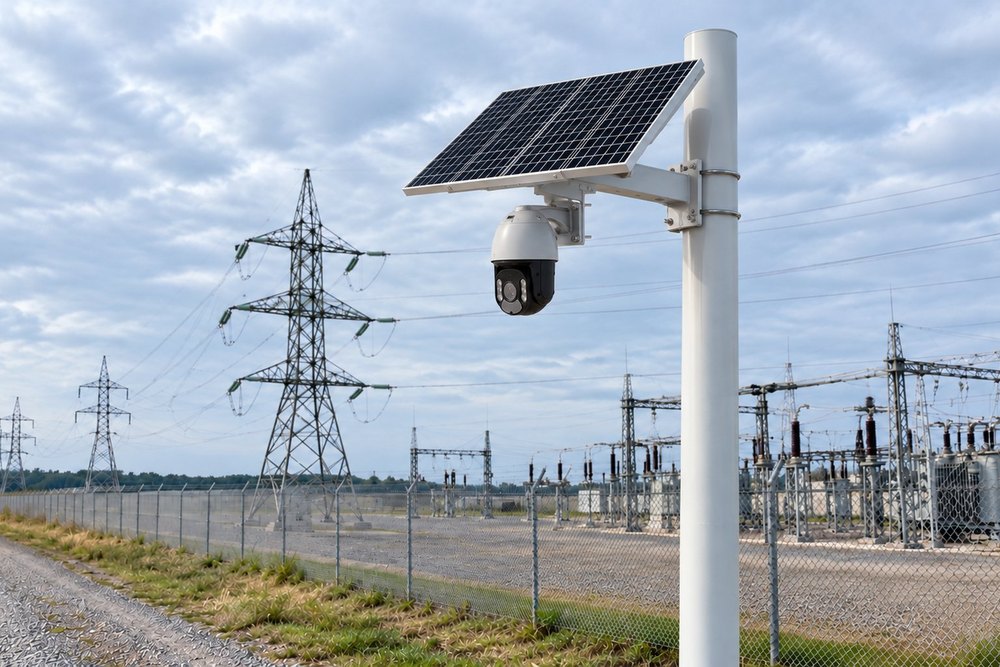
Where the perimeter belongs to an electrical site rather than open ground, the freestanding-pole layout under solar power for substation and plant cameras keeps the fence line untouched.
Asked by Fence-Line Owners and Installers
Can one system cover a kilometre of fence line?
Can the same system run the gate motor or barrier?
What stops the panel and battery being taken or damaged?
Does the system work where the site has no network coverage?
Send the Perimeter, Get a Point-by-Point Plan
Tell us the fence length, the gates, and the camera and link models you intend to use. We will map it onto standard sizes and quote them FOB China. We are not the factory: we supply these standard systems, so if a point genuinely needs something else we will say so.
Plan the points
Fence length, gates, camera models. We will come back with how many systems and which size for each point, typically within 24 hours.
Ask Us to Plan ItCheck the numbers
Panel, battery, output and bracket for every standard size, on the product pages, so you can check the load arithmetic yourself.
See the DataMinimum order 2 pcs · FOB China · Payment is 100% in advance, by T/T bank transfer · Standard models · Typical lead time ~15 days