
Solar Power for Warehouse Security Cameras
A logistics yard is a working surface: trailers arriving before the shift, a dock face that is blind from the gate, and a far stack that nobody walks past overnight. Solar power for warehouse security cameras puts the camera at the point that needs watching, without cutting a duct across the apron or taking the yard out of service.
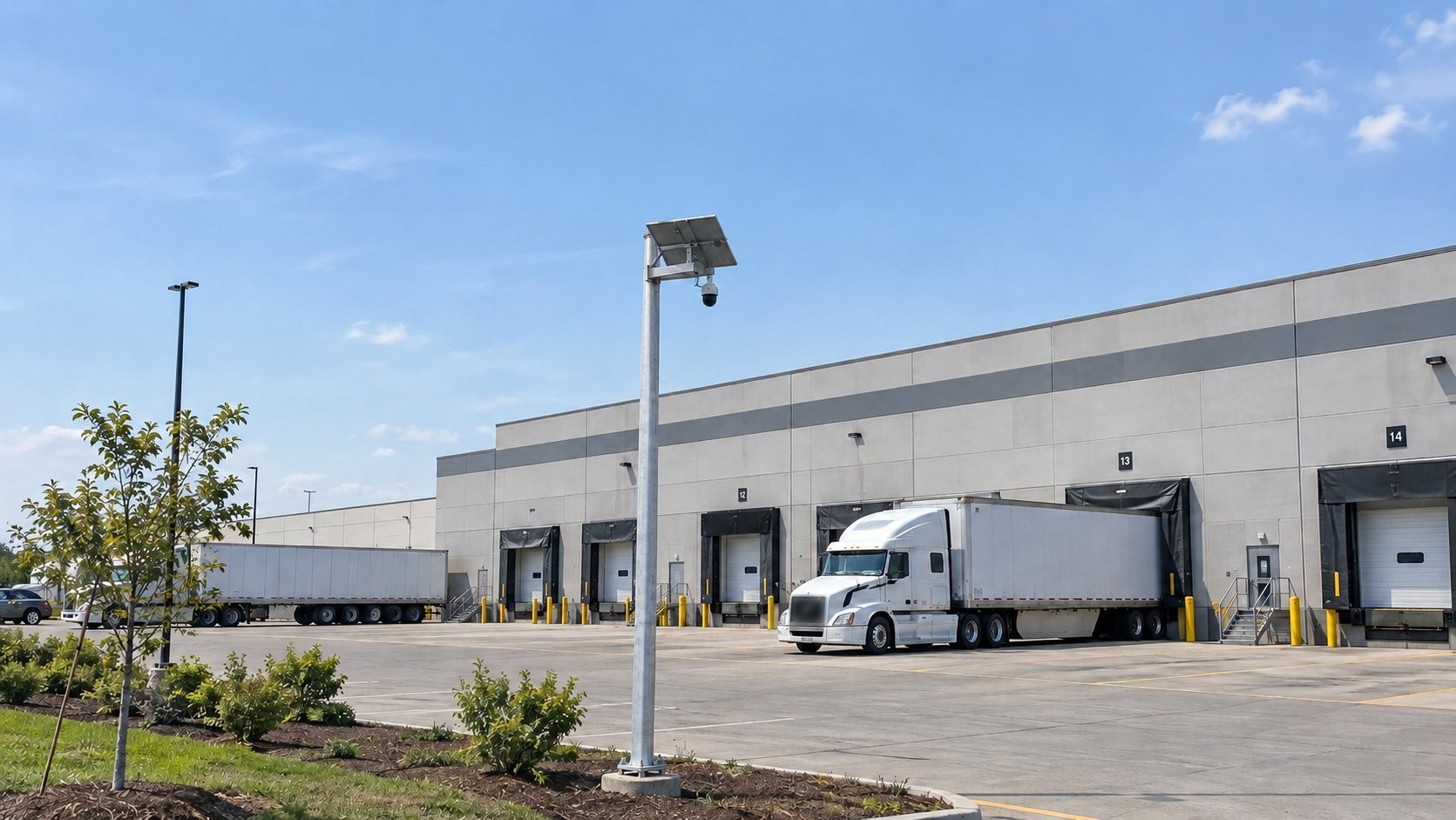
An Apron Built for Trailers, and a Camera That Needs a Cable
Coverage is usually wanted where the traffic is: the gate lane, the dock doors, the reversing apron, the far end of the stack. Bringing mains power to those points means cutting a duct across the yard, taking it past the turning circles, and reinstating a surface built to carry loaded trailers and forklifts.
The camera itself is the smallest line in the quote. The duct is the large one: saw cutting, enough depth to stay below a loaded apron, the drainage falls it crosses, and the days the yard spends half closed while the work is done. A solar power system removes that work. The panel, the battery box and the camera go on a mast, a wall or a post that already stands where coverage is wanted.
- No duct across the yard: nothing is opened, so no apron has to be rebuilt
- No yard closures: the installation does not take the surface out of use
- Coverage at any stack: not limited to where an existing duct happens to end
- Carries the dark hours: the battery runs the cameras and the gate router when the yard is empty
What a Yard Point Usually Draws
Add up the devices at one point, not across the whole site. These are our working reference figures: check your own camera and router labels before ordering.
| Gate and ANPR lane | 1 plate recognition camera plus 1 overview camera (5–10 W each) |
| Dock doors and reversing apron | 1 overview camera per pair of dock doors (5–10 W) |
| Yard and container stack | 1 mid-size PTZ camera (5–10 W) per coverage point |
| Gatehouse or kiosk | 1 camera (5–10 W), plus a small DC 12V router (≈8 W) if video is relayed there |
Recommended load depends on the actual power draw of your cameras and router; total continuous load must not exceed 60 W (5 A at DC 12V). If the cameras are not chosen yet, start with how many watts of solar panel a CCTV camera needs and come back with the total.
One Point, One Self-Contained System
Everything at a coverage point is powered from one standard system: panel, battery and outputs on the same pole or wall. The diagram shows how the pieces connect; the loads column is where your camera and router draw sits.
Total continuous load must not exceed 60 W (5 A at DC 12V). Recommended load depends on the actual draw of your cameras and router. Send us the models and we will check it for you.
Three Yard Situations, Three Standard Models
One gate, near yard
YO-M8040: 80 W of panel, 40 Ah battery, 10.0 kg, on a steel bracket. Enough for the gate lane and the near end of the yard, fitted to the gatehouse wall or a post beside it.
Gate plus dock line
YO-P12060: 120 W and 60 Ah, enough for 3–4 mid-size PTZ cameras plus a router. The usual choice where the gate, the dock doors and the first stack all need cover.
Open yard or an exposed mast
YO-P12060-T: the same power core on a triangle bracket with pole clamps, for masts and posts rather than flat walls. For several coverage points across a large yard, YO-P240120‘s 240 W frame is the step up.
Camera counts are indicative only. Actual compatibility depends on the combined continuous power draw of all connected devices, including the router. The total load must remain within the system’s 60 W (5 A at DC 12V) output limit. Panel ratings (80 W, 120 W, 240 W) describe how much the panel array can harvest, not how much the output can deliver: the output limit is the same 60 W (5 A at DC 12V) on all four standard models.
Gate plus dock line usually comes down to the 60 W solar power system for camera, with the smaller frame kept for a gate that stands on its own.
Mounting Without Crossing the Apron
Yard lighting masts
A logistics yard already has lighting masts, and they stand over the working areas where coverage is wanted. A clamp band gets the panel and the camera up at height without a foundation in the middle of the apron.
Warehouse wall and dock canopy
The dock face carries the doors, the canopy edge and the building wall. A wall or canopy bracket keeps the battery box off the ground and out of the traffic envelope. Check with whoever services the doors before drilling into the canopy.
Perimeter fence and gate posts
Where the boundary runs past the far stack, a fence or gate post is often the shortest route to a coverage point that has no building near it.
Panel orientation and shading
Face the panel toward the equator and keep it clear of the tallest things around it: the building itself, the canopy, sign gantries and the container stack. The stack changes height through the year, so check the shading again after the yard layout moves.
Four Things That Only Matter in a Yard
1. The apron is built for trailers, not for digging
Reinstating heavy-duty pavement is a different job from patching a kerb. The duct has to sit deep enough for loaded trailers and forklifts, it crosses drainage falls, and the repair has to carry the same loads as the surface around it. None of that work is needed by a self-contained system, which is why the saving on a yard is larger than the saving on a wall.
2. The dock face is the blind side of the building
From the gate you can see most of the yard. What you cannot see is what stands behind a trailer at a dock door. The useful dock positions therefore sit high on the canopy edge and look down and along the reversing apron rather than straight out. Mornings put the sun behind the building, so it is worth checking the camera view and the panel angle at the same time of day.
3. Power at the gatehouse does not reach the far stack
A gatehouse usually has mains and a network cabinet already. The problem is the other end of the yard, several hundred metres away, with vehicles running over any route between the two. Placing the system at the point of use instead means the distance stops being the deciding factor, and there is nothing in the traffic envelope to protect.
4. The far fence line sits outside the lighting
Yard lighting is aimed at the working areas: the doors, the loading lanes and the fuel point. The boundary fence and the rear of the stack fall outside those pools of light, and those are exactly the positions with no supply to borrow. That is where a self-contained system earns its place, rather than duplicating a point that already has power beside it.
Asked by Yard and Site Managers
How many cameras can one system power in a yard?
Can it power the dock doors or the yard lighting?
Do we have to cut a duct across the apron?
Will the container stack shade the panel?
The Same Hardware in a Different Yard
Coverage points that move every few weeks change the answer. On a site that is still being built the same rig is bolted to whatever stands where the work is, which is construction site security camera solar power rather than a permanent yard mount. Where the boundary is a gate and a marked bay instead of a working apron, the layout notes under solar power for parking lot camera cover what differs.
Can one solar panel power multiple cameras? That and the other general sizing questions are answered on the FAQ page.
Where the boundary is a field gate and a fence line rather than a dock apron, the crop and gate cases sit under solar power for farm security cameras.
Tell Us What the Yard Needs to Watch
Send the camera models, how many sit at the gate, the dock line and the far stack, and whether a router is powered out there too. We will confirm the right standard model and quote it FOB China, typically with a reply within 24 hours, Mon–Sat.