
Solar Power for Construction Site Cameras
A construction site is a site with no permanent services, a shifting layout and someone else’s cable to blame. A standard solar power system keeps cameras watching the entrance, the perimeter and the materials store from day one, then moves on to the next phase with the rest of the site.
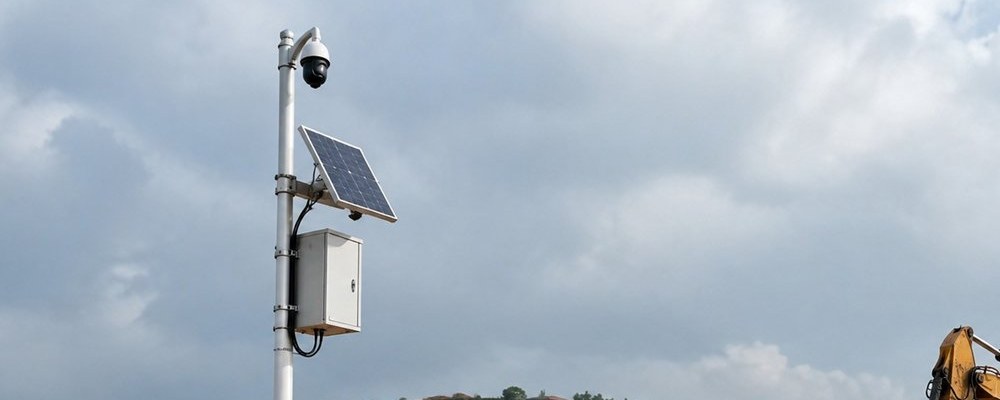
No Permanent Supply, and a Layout That Keeps Moving
Site cameras usually go up long before the building has services. Temporary supply arrives late, moves with the site office, or is switched off at the end of the shift. A generator needs fuel delivered to the site, and it is normally shut down overnight, exactly when a materials store or an unattended compound is of interest to somebody.
Trenching a temporary cable is worse: it crosses ground that will be excavated next week, it gets cut by tracked plant, and it has to be removed again before hand-over. A solar power system avoids the need for mains supply cables or buried power cables to the camera location. The camera and other supported devices still connect to the system’s DC output.
- Installs on day one: no waiting for temporary supply to reach the point
- No fuel, no generator: nothing to deliver, nothing to run dry
- Keeps working at night: the battery carries the load when the generator is off
- Nothing buried: no mains or supply cable for an excavator to find
What a Site Point Usually Draws
Work through the devices at one point, not across the whole site. These are our working reference figures. For the device-by-device method, see our guide to solar power system sizing for CCTV. Check your own camera and router labels before ordering.
| Site entrance | 1–2 mid-size PTZ cameras (5–10 W each) watching the gate and the access road |
| Perimeter or fence line | 1 mid-size PTZ camera (5–10 W) plus its own router if the point is remote |
| Materials store or compound | 2 cameras (5–10 W each), often the highest-value point on the site |
| Site office viewing | 1 DC 12V router (≈8 W) so the site office can pull the cameras up on a screen |
Recommended load depends on the actual power draw of your cameras and router; total continuous load must not exceed 60 W (5 A at DC 12V).
One Point, One Self-Contained System
Everything at a coverage point is powered from one standard system: panel, battery and outputs on the same pole or wall. The diagram shows how the pieces connect; the loads column is where your camera and router draw sits.
Total continuous load must not exceed 60 W (5 A at DC 12V). Recommended load depends on the actual draw of your cameras and router. Send us the models and we will check it for you.
Three Site Situations, Three Standard Models
Gate or single compound point
YO-M8040: 80W of panel, 40Ah battery, 10.0 kg, on a steel bracket. Quick to fit on a temporary post or a container corner, and quick to move again.
Entrance plus perimeter coverage
YO-P12060: 120W and 60Ah, enough for 3–4 mid-size PTZ cameras plus a router. That count is a worked example for low-power cameras and is not a figure that holds for every model. The usual choice where one point has to cover more than the gate itself.
Exposed pole, or a long wet season
YO-P12060-T: the same power core on a heavy-duty triangle bracket with pole clamps, for positions where the panel has to be carried on an exposed pole rather than on a wall. For multi-point compounds, YO-P240120‘s 240W frame is the step up.
Camera counts are indicative only. Actual compatibility depends on the combined continuous power draw of all connected devices, including the router. The total load must remain within the system’s 60 W (5 A at DC 12V) output limit. Panel ratings (80 W, 120 W, 240 W) describe how much the panel array can harvest, not how much the output can deliver: the output limit is the same 60 W (5 A at DC 12V) on all four standard models.
Mounting Without a Foundation
Hoarding and fencing
Site hoarding takes a bracket directly, which gets the panel up at height without a new post. Check that the bracket is firmly fixed, and that the panel is not shaded by the hoarding behind it.
Container corners and site cabins
For the materials compound, the corner casting of a container or the gable of a cabin gives a solid fixing point above ground level, and keeps the battery box away from passing plant.
Temporary posts and frames
Where nothing exists, a driven or ballasted temporary post carries both panel and camera: this is the position the pole-mounted solar power system is supplied for. Ballasted bases are easier to move on to the next phase than anything driven into the ground.
Panel orientation
Face the panel toward the equator and out of the shadow of the tallest thing on site, which, on a construction site, changes month by month as the structure rises. Re-check the shading when the site layout changes.
Four Things That Only Matter on a Site
1. The system moves with the phase, not with the ground
Site layouts change: the compound relocates, the access road is cut in somewhere else, and the camera that watched the gate last month is watching nothing this month. Because nothing is buried and no foundation is poured, a standard system can be unbolted, moved and re-fitted at the next position, panel, bracket, battery box and camera together. Plan the camera positions per phase, and the hardware follows.
2. Dust and mud film is the real output killer
On a site, a panel does not fail; it gets dirty. Cutting, loading and haulage throw a fine film onto the glass, and a shaded or filmed panel produces noticeably less. Position the panel away from the main dust sources where you can, and wipe it down when you check the camera. The battery box is sealed to IP65 (rain and splash resistant) and should not be pressure-washed or hosed at close range; it is not designed for immersion.
3. Cable runs removed from the excavation zone
Temporary supply cables on a site can be cut by tracked plant, damaged by excavation, or removed when the compound moves. A self-contained solar power system eliminates the need for mains supply cables or buried power cables to the camera location. The camera and any supported router still connect to the system’s DC output. This reduces the risk of cable-related disruption during site works. That is also why the load has to be added up honestly at the outset: nothing is coming from elsewhere.
4. Unattended compounds need the unit out of reach
An unlit, unattended materials compound is the spot where equipment walks. Fit the panel and camera at height, mount the battery box above easy-reach level, and use standard fixings that are awkward to undo quickly. A ballasted or clamped base also means the unit arrives and leaves in one piece rather than being dismantled on site. Damage, theft and vandalism sit outside the warranty, so placement is the control that matters. Gate, compound and fence-line layouts are grouped under off-grid solar power for security cameras.
Asked by Site and Project Buyers
How many cameras can one system power at the entrance?
Can I move it to the next phase of the project?
Does it work in winter or on a dusty site?
Do I need a generator as backup?
When the Site Stops Moving
A build finishes and the coverage points stay where they are. Once the site becomes a permanent yard, the questions move from relocating gear to working around traffic, which is what solar power for warehouse security camera covers: dock, gate and stack positions on a surface built for loaded vehicles. Where the boundary is a marked bay rather than a working apron, the layout notes under solar power for parking lot camera follow the difference in traffic.
Tell Us What the Site Needs to Watch
Send the camera models, how many at each point, and whether a router is powered there too. We will confirm the right standard model and quote it FOB China, typically with a reply within 24 hours, Mon–Sat.