
Solar Power for Farm and Ranch Cameras
Gate cameras, barn and paddock coverage, feed stores and equipment yards: farms are usually the furthest sites from a power drop, and the least likely to justify a trench. A standard solar power system puts a camera exactly where you need it, with no cable to bury and no monthly bill. For most buyers this is the shortest route to solar power for farm security cameras: one self-contained unit at each point instead of one long cable run.
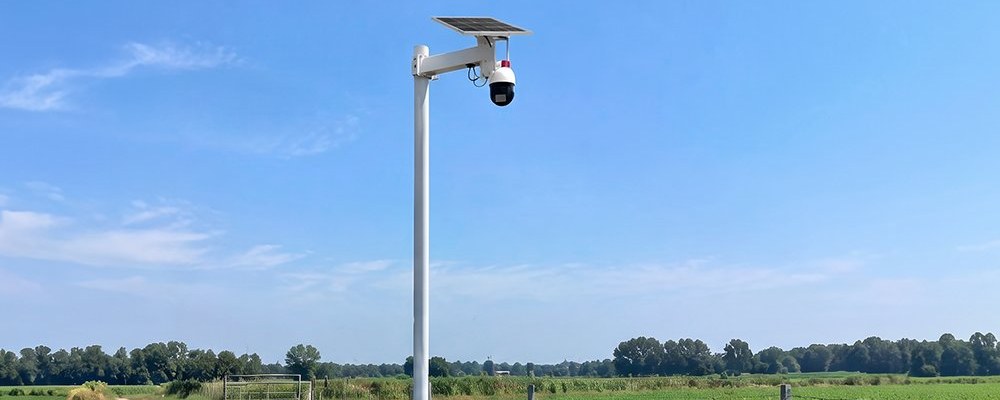
Distant Poles, Long Cables, No Grid
A farm is a scatter of points rather than one building. The gate that matters is often a kilometre from the house; the paddock you want to watch has no structure to mount from and no socket within reach.
Running mains out to those points means trenching, conduit and a licensed electrician. That is a fixed cost that is hard to justify for one camera, and awkward to repeat each time you move a gate or add a water trough. A solar power system turns each point into its own self-contained installation.
- No trenching: no conduit, no cable damage from ploughing or livestock
- No grid connection: works where there is no supply at all
- Relocatable: unbolt it, move it with the gate or the paddock
- One unit, one point: a fault at one camera does not take down the rest
What Farm Security Cameras Usually Draw
Add up the rated draw of the devices at one point. These are our working reference figures. Check your own camera and router labels before ordering.
| Single gate camera | 1 mid-size PTZ camera (5–10 W) for entry and exit coverage, night vision on |
| Barn or paddock point | 2 mid-size PTZ cameras (5–10 W each), one wide view plus one on the door or trough |
| Remote viewing | 1 DC 12V router (≈8 W), the piece most farm installs forget when sizing |
| Water or equipment yard | 2 cameras plus one router, on a site where nobody visits for weeks |
Recommended load depends on the actual power draw of your cameras and router; total continuous load must not exceed 60 W (5 A at DC 12V). If you prefer to work it out from the labels yourself, here is how to size a solar power system for CCTV cameras.
One Point, One Self-Contained System
Everything at a coverage point is powered from one standard system: panel, battery and outputs on the same pole or wall. The diagram shows how the pieces connect; the loads column is where your camera and router draw sits.
Total continuous load must not exceed 60 W (5 A at DC 12V). Recommended load depends on the actual draw of your cameras and router. Send us the models and we will check it for you.
Three Farm Layouts, Three Standard Models
One gate or barn point
YO-M8040: this 80W solar power system pairs an 80W panel with a 40Ah battery on a steel bracket. Pole or wall mount, 10.0 kg, easy for one person to install. It covers one entry point with 2–3 mid-size PTZ cameras (5–10 W each) plus a DC 12V router. That count is a worked example for low-power cameras and is not a figure that holds for every model; the binding limit is the total continuous load, which must stay under 60 W.
Barn plus paddock, several cameras
YO-P12060: a 120W solar power system with a 60Ah battery, sized for 3–4 mid-size PTZ cameras plus a router at the 5–10 W per camera typical of farm installs. As with the other models, that count is a worked example for low-power cameras and not a figure that holds for every model, so check your own labels and keep the total under 60 W (5 A). This is the usual choice when one point has to cover more than a doorway.
Fence line or long rain season
YO-P12060-T: a pole-mounted solar power system using the same power core on a heavy-duty triangle bracket, for fence lines where the panel has to be carried on the post itself rather than on a wall. For multi-point yards, YO-P240120‘s 240W frame is the step up.
Camera counts are indicative only. Actual compatibility depends on the combined continuous power draw of all connected devices, including the router. The total load must remain within the system’s 60 W (5 A at DC 12V) output limit.
Mounting on a Farm
Pole mounting
Both brackets fix to an existing or new steel or timber pole. Panel above, camera below, sealed battery box on the pole between them. That keeps the cable runs short and the box out of reach of machinery.
Barn and shed walls
A south-facing wall or gable end carries the panel, with the box mounted on the shaded side of the same wall. Avoid roof positions you cannot safely reach for cleaning.
Panel orientation and shading
Face the panel toward the equator and clear of shadows at every hour that matters. On a farm the usual culprits are tree lines, hay bales and the buildings themselves. Check at midday and again in the late afternoon.
Cable routing
Keep the runs between panel, controller, battery and camera as short as the site allows, and protect any exposed cable. Long DC runs lose voltage, which shows up as a camera that drops out and restarts.
Three Things That Only Matter on a Farm
1. Livestock rubbing, chewing and leaning
Cattle, horses and goats investigate anything new, and a wall-mounted box at shoulder height becomes a scratching post. Mount the sealed battery box above the tallest animal’s reach (typically higher than head height), keep the panel clear of the paddock fence line where animals crowd, and conceal any exposed cable inside conduit or a cable duct on the pole. Damage from animals is not covered by warranty, so this is a five-minute decision that saves a support conversation later.
2. Winter sun, shade and cold capacity
Two effects hit at once. Days get shorter and the sun sits lower, so panel output drops; and a lithium battery at low temperature gives up usable capacity. Treat the rainy-autonomy figure as the one to plan against, not the summer best case, and reposition the panel if a tree line has grown into its afternoon shadow since the site was first set up.
3. Scattered points beat one long cable run
The instinct is to buy one big system and run cable out to several points. On DC 12V that is usually the wrong trade: voltage drops along the run, every camera then needs its own adapter, and a single fault takes down the whole group. One standard system at each point keeps the wiring short, the diagnosis simple and the failure contained. It also matches how farms actually change: gates move, paddocks rotate, and a system that follows is worth more than a fixed one. The same reasoning applies to solar power for remote security and perimeter monitoring on gateways, yards and fence lines.
Asked by Farm and Ranch Buyers
How many cameras can one system power at a gate?
Do I need to run any cable or dig a trench?
Will it keep running through a wet winter?
Can I move the system when I move the gate or fence?
Tell Us Where the Cameras Are Going
Send the camera models, how many at each point, and whether a router is powered there too. We will confirm the right standard model and quote it FOB China, typically with a reply within 24 hours, Mon–Sat. One figure to send with it: every model shares the same DC 12V output limit of 60 W (5 A) in total.