
Solar Power for Parking Lot Cameras
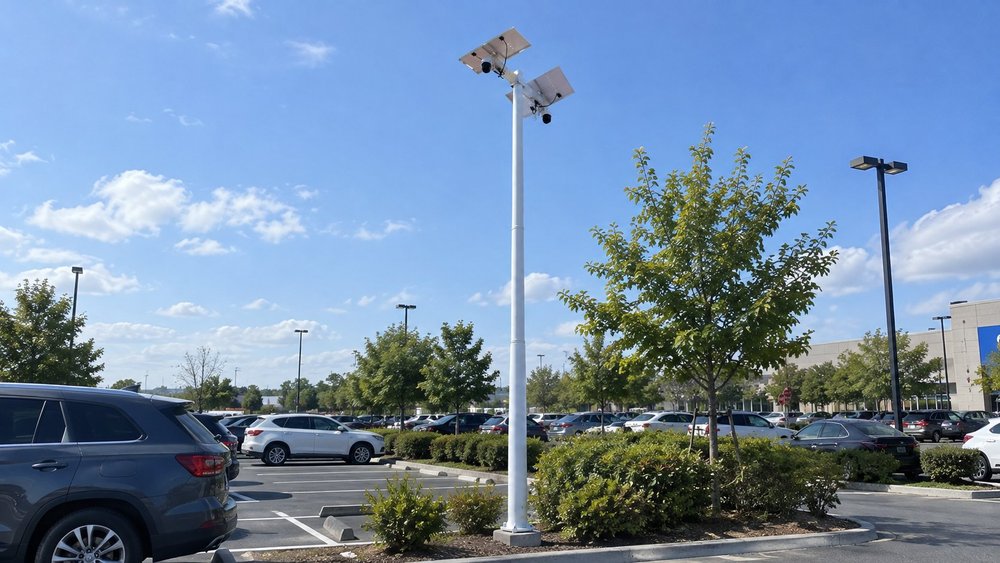
A parking lot is a surface with a camera problem in the middle of it: the entry lane, the pay station and the far rows all need coverage, and none of them sits next to a power point. Solar power systems for parking lot CCTV are built for exactly that gap, and a standard unit mounts on a structure the lot already has: the camera goes where the traffic is, without cutting the surface or pulling a cable under the kerb.
Asphalt, Kerbs and a Meter on the Wrong Side
Cameras in a parking lot are usually wanted at the points furthest from the building: the entry and exit lanes, the pay station, the back row behind the loading area. Bringing mains power to those points means cutting the surface, laying conduit, reinstating the asphalt and keeping part of the lot closed while it is done.
The cost of all that rarely sits in the cable. It sits in the saw cutting, the traffic control, the reinstatement and the fact that a repaired strip never quite matches the surface around it. A solar power system avoids the excavation completely: the panel, the battery box and the camera go on a post, a lighting column or a wall that is already there.
- No saw cutting: nothing is opened, so nothing has to be reinstated
- No lane closures: the camera goes up without occupying the surface
- Installs at any point: no dependency on where the nearest duct ends
- Works through the night: the battery carries the load when the lot is empty
What a Parking Point Usually Draws
Add up the devices at one point, not across the whole lot. These are our working reference figures: check your own camera and router labels before ordering.
| Entry or exit lane | 1 plate recognition camera plus 1 overview camera (5–10 W each) |
| Pay station or kiosk | 1 camera (5–10 W), plus a small DC 12V router (≈8 W) if the kiosk relays video |
| Remote row ends | 1 mid-size PTZ camera (5–10 W) per point, watching the back rows |
| Service yard or access road | 1–2 cameras (5–10 W each) covering deliveries and staff parking |
Recommended load depends on the actual power draw of your cameras and router; total continuous load must not exceed 60 W (5 A at DC 12V).
One Point, One Self-Contained System
Everything at a coverage point is powered from one standard system: panel, battery and outputs on the same pole or wall. The diagram shows how the pieces connect; the loads column is where your camera and router draw sits.
Total continuous load must not exceed 60 W (5 A at DC 12V). Recommended load depends on the actual draw of your cameras and router. Send us the models and we will check it for you.
Three Lot Situations, Three Standard Models
One lane, one point
YO-M8040: 80 W of panel and a 40 Ah battery, 10.0 kg, on a steel bracket. It fits a lane where a plate camera and an overview camera share one point, as long as their combined continuous draw stays inside the system’s 60 W (5 A at DC 12V) output limit. Mounts on a column or a wall beside the lane.
Lane plus pay station
YO-P12060: a 120 W solar panel and a 60 Ah battery for parking-lot camera points with a moderate combined load. It may suit a lane, a kiosk or an adjacent coverage area when the camera and router power requirements fit within the system’s 60 W continuous DC output limit. Confirm the actual device models and power draw before selecting this configuration.
Exposed column or a long wet season
YO-P12060-T: the same power core on a triangle bracket with pole clamps, for columns and posts rather than flat walls. For more points across a large lot, YO-P240120 steps the panel up to 240 W and the battery to 120 Ah. The larger panel and battery are there to harvest and store more energy across more points, not to raise the output limit: it stays at 60 W (5 A at DC 12V) on all four standard models.
Camera counts are indicative only. Actual compatibility depends on the combined continuous power draw of all connected devices, including the router. The total load must remain within the system’s 60 W (5 A at DC 12V) output limit. Panel ratings (80 W, 120 W, 240 W) describe how much the panel array can harvest, not how much the output can deliver: the output limit is the same 60 W (5 A at DC 12V) on all four standard models.
Mounting Without Touching the Surface
A pole-mounted solar power system is the usual answer in a lot: the structure that is already there does the carrying, and only the fixings are new. Lighting columns and dedicated posts are the first choice; anything else gets a check first.
Lighting columns and dedicated posts
A lot is usually already full of columns, and they stand exactly where coverage is wanted. A clamp band gets the panel and camera up at height without a new post, and without a concrete base in the middle of the surface. Where no column sits in the right spot, a dedicated post is the next option.
Gate housings and kiosk frames, after a check
The gate housing and the pay station frame can carry the bracket for the lane cameras and keep the battery box off the ground. But the gate is equipment that someone else services: vibration, access and warranty terms all belong to whoever maintains it. Treat this as an option to confirm, not a default.
Perimeter walls and fences
Where the boundary wall runs past the far rows, a wall bracket is often the shortest route to a coverage point that has no other structure near it.
Panel orientation and shading
Face the panel toward the equator, clear of the tallest things around it. In a lot that means tree canopies, sign gantries and the building itself: check the shading again in winter, when the sun sits lower.
Four Things That Only Matter in a Lot
1. The expensive part is the reinstatement, not the cable
Running power across a lot means saw cutting, conduit, backfill and a repair strip that stays visible for years. It also means closing part of the surface while the work happens, which is the part that gets noticed by whoever runs the site. Nothing in a self-contained system touches the surface: the bracket fixes to something that already stands there, and the unit can be moved later if the lanes are reconfigured.
2. The gate and the plate camera share one point
At the entry lane, the plate recognition camera, the overview camera and the intercom all sit within a few metres of the gate housing. That concentration is helpful: one system covers the whole lane. It is also worth being clear about the limit. Our standard output is designed for camera, router and intercom loads, not for the gate motor, which draws a start-up current well above its running figure. The barrier mechanism keeps its own supply.
3. The columns are already in the right places
Lighting columns, sign posts and fence lines follow the geometry of the lot, which is also the geometry of the coverage. Reusing them avoids new foundations and keeps the hardware out of the traffic envelope. Two details matter on a column mount: the panel should not be shaded by the luminaire arm above it, and the camera should sit far enough below the light to avoid glare washing out the picture at night.
4. The hours that matter are the empty ones
During the day a lot is busy and observed. Between the last departure and the first arrival it is empty, and that is when the incidents happen. The battery carries the cameras and the router through that window on its own, which is also why the load has to be added up honestly at the outset: nothing is coming from elsewhere. Size for the shortest days of the year rather than a midsummer best case.
For reliable overnight and winter operation, size the system using the camera’s actual day-and-night power consumption, including infrared illumination, heaters and PTZ activity where applicable. Allow for local winter solar conditions, shading and the required battery autonomy during consecutive low-sun days. Final sizing depends on the site location, equipment load and required runtime. We do not quote a fixed number of autonomy days, because it changes with the site: send us the location and the load, and we will size it against your worst month.
Asked by Lot Owners and Installers
How many cameras can one system power at an entry lane?
Can it power the barrier gate as well?
Do we have to break the surface to install it?
What about shading from trees and the building?
Where the Same Kit Goes Next
A car park and a working yard differ in what runs over the surface. Where trailers and forklifts do the turning and the far stack has no supply to borrow, the notes under solar power for warehouse security camera cover the heavier traffic envelope. Where the coverage points still move as the work moves, construction site security camera solar power is the closer match.
Tell Us What the Lot Needs to Watch
Send the camera models, how many sit at each lane or kiosk, and whether a router is powered there too. We will confirm the right standard model and quote it FOB China, typically with a reply within 24 hours, Mon–Sat. We are a solar CCTV power system supplier rather than a site contractor: the hardware ships to you, and your installers handle the mounting and wiring.